Pacemaker implantation after transcatheter aortic valve replacement in nonagenarians
European Heart Journal


Abstract
Transcatheter aortic valve replacement (TAVR) improves outcomes in patients with severe aortic stenosis and is increasingly used in nonagenarians. Limited evidence exists on the incidence and predictors of conduction abnormalities requiring permanent pacemaker (PPM) implantation in this population.
To investigate the incidence and predictors of PPM implantation in nonagenarians after TAVR.
All patients undergone TAVR were screened from a high-volume US center and nonagenarians were included in the analysis. Baseline demographics, co-morbidities, medication use, pre/post-procedural ECG features, valve type/size, temporary transvenous pacemaker (TVP) placement, backup pacing needs, extended telemetry monitor findings were summarized.
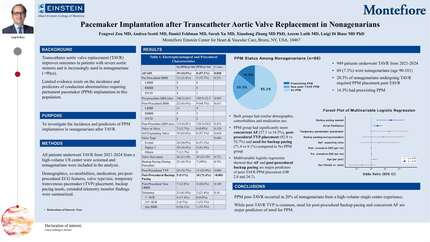
A total of 949 patients underwent TAVR from 2021-2023 and 69 (7.3%) were nonagenarians (age 90-101). Among nonagenarians undergoing TAVR, 14 (20.3%) required PPM placement post-TAVR and 10 (14.5%) had preexisting PPM. Post-TAVR TVP placement is common in 60.9% patients. Patients requiring post-TAVR PPM (PPM group) had significantly more concurrent AF (57.1 vs 34.5%), post-procedural TVP placement (92.9 vs 52.7%) and need for backup pacing (71.4 vs 9.1%) compared to No PPM group. Both groups had similar age, gender, comorbidities including CAD, HTN, DM, renal dysfunction and CVA, LVEF, and medication use (Table 1). There were also no significant differences in pre/post-procedural bundle branch block pattern, valve type and size, and need for pacing during procedure (Table 2). Multivariable logistic regression (Table 3) demonstrated that AF and confirmed need for post-procedural backup pacing are major predictors of post-TAVR PPM placement (OR 2.8 and 24.7).
PPM post-TAVR occurred in 20% of nonagenarians from a high-volume single center experience. While post-TAVR TVP is common, confirmed need for post-procedural backup pacing and concurrent AF are major predictors of need for PPM.


You may be interested in