Sex-specific hemodynamic changes in vasovagal syncope patients with positive tilt test
European Heart Journal


Abstract
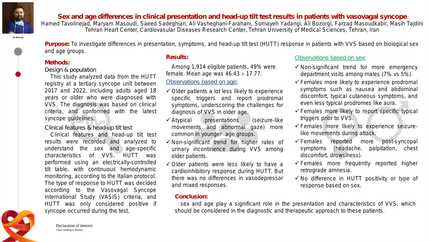
Head-up tilt test (HUTT) is widely used to assess patients with suspected vasovagal syncope (VVS). Despite being clinically useful, little has been reported on hemodynamic changes during HUTT, especially in relation to sex differences. This knowledge is necessary for optimizing treatment algorithms for individuals afflicted with VVS.
This study aimed to compare sex-specific hemodynamic changes during HUTT in patients with vasovagal syncope, focusing on differences in blood pressure, heart rate, and response types between males and females.
We conducted a retrospective analysis of data from the Syncope Unit of a Tertiary Center (2017–2024). The study included adults (≥18 years) diagnosed with VVS based on clinical history and physical examinations, in accordance with current syncope guidelines. A positive HUTT result was defined as a complete loss of consciousness, as determined by the physician conducting the test. The HUTT was performed using an electrically controlled tilt table, following the Italian protocol, with continuous blood pressure and heart rate monitoring. Hemodynamic parameters were analyzed in 1005 patients with a positive HUTT result, stratified by sex and test phase (passive vs. active). Continuous variables were compared using the Wilcoxon rank-sum test, and categorical variables were compared using Pearson’s chi-squared test.
Of the 1005 patients included, 50.3% were female (median age: 46 [30–62]). Male patients were older than females at the time of the tilt test (median age: 51 vs. 43 years, P<0.001). In the passive phase, no significant differences in response types were observed between the sexes. However, females exhibited a greater median reduction in diastolic blood pressure compared to males (46 mmHg vs. 37 mmHg, P=0.02). During the active phase, males demonstrated a higher rate of vasodepressor response compared to females (36% vs. 29%, P=0.03). No significant differences were observed in systolic or diastolic blood pressure reductions between sexes during this phase. However, females showed a significantly greater median reduction in heart rate compared to males (38 bpm vs. 29 bpm, P<0.001).
These results implicate possible physiological differences in autonomic regulation between the sexes which may be relevant for personalized diagnostic and therapeutic strategies in the management of VVS.
Contributors



You may be interested in