Utility of the HFA-PEFF score in patients with sick sinus syndrome after pacemaker implantation for predicting outcomes
European Heart Journal


Abstract
Previous studies have demonstrated that sick sinus syndrome (SSS) is associated with atrial fibrillation (AF) and heart failure with preserved ejection fraction (HFpEF). However, diagnosing and predicting outcomes in patients with both SSS and HFpEF remains challenging. The European Society of Cardiology has proposed using the HFA–PEFF score for HFpEF diagnosis.
This study aimed to assess the AF burden and the incidence of cardiovascular events in patients with SSS after pacemaker implantation and investigated its relationship with HFpEF diagnosed using the HFA-PEFF score.
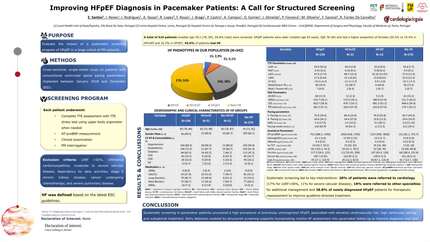
We retrospectively identified 131 patients with symptomatic SSS and preserved ejection fraction who underwent pacemaker implantation between January 2019 and December 2021. Among them, 52 patients (39.7%) had a HFA-PEFF score of ≥5, meeting the diagnostic criteria for HFpEF.
Patients with HFpEF had a significantly higher incidence of cardiovascular events (28.8% vs. 11.4%; p = 0.009) within three years after pacemaker implantation compared to those without HFpEF. Additionally, patients with HFpEF had a higher incidence of AF lasting ≥1 hour (80.8% vs. 53.4%; p < 0.001), ≥1 day (55.8% vs. 26.8%; p = 0.002), and ≥7 days (32.9% vs. 16.9%; p = 0.038). A simplified HFA-PEFF score incorporating only E/e’, tricuspid regurgitation peak gradient, left atrial volume index, and brain natriuretic peptide was similarly predictive of cardiovascular events and AF burden.
Patients with HFpEF have a higher incidence of cardiovascular events and a greater AF burden within three years after pacemaker implantation for SSS. The HFA-PEFF score may be useful for risk stratification in these patients.
Contributors

You may be interested in