Predicting recurrence and outcomes after triggered atrial fibrillation using deep learning
European Heart Journal


Abstract
Triggered atrial fibrillation (AF) is defined as new-onset AF occurring after an acute precipitating event, and may recur months or even years after the initial episode. Though long-term AF recurrence is increasingly recognized as an important marker for increased risk of AF-related adverse outcomes including stroke, risk stratification methods to guide longitudinal rhythm surveillance are limited. Artificial intelligence (AI) derived AF risk based on a 12-lead electrocardiogram has shown substantial predictive utility for incident AF and associated-outcomes and may do so for triggered AF as well.
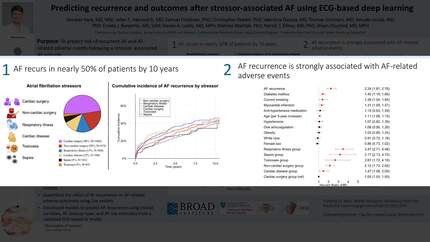
We retrospectively analyzed 3,371 patients in an ambulatory cohort of primary care and cardiology patients with triggered AF occurring during a hospitalization. We examined associations between clinical covariates, common AF triggers, and AF recurrence using Fine-Gray models accounting for death as a competing risk. We investigated the association between AF recurrence (as a time-varying covariate) and a composite endpoint of AF-related adverse events (defined as stroke, heart failure, or all-cause mortality) using Cox proportional hazards models. We then developed and validated a penalized regression model to predict AF recurrence incorporating clinical factors, AF triggers, and predictions from a previously developed 12-lead ECG-based deep learning model that stratifies future AF risk.
Over a median follow-up of 3.8 years, the 10-year subdistribution cumulative incidence of AF recurrence was 41% (95% CI 39-44). Recurrence rates varied by trigger, with respiratory illness-associated AF exhibiting the highest (46%, 95% CI 40-53) and sepsis-associated AF the lowest (34%, 95% CI 24-44). Time-varying AF recurrence was strongly associated with both increased adverse event risk (HR 2.29, 95% CI 1.87–2.80) as were other clinical factors including diabetes (HR 1.40, 95% CI 1.18-1.67) and current smoking (HR 1.39, 95% CI 1.04-1.84). A predictive model incorporating clinical factors, AF triggers, and deep learning-based AF predictions demonstrated moderate discrimination for AF recurrence (AUROC 0.768, 95% CI 0.707-0.830), surpassing models based on clinical features alone (AUROC 0.707, 95% CI 0.642-0.772).
AF recurrence is common after triggered AF and is associated with a substantially higher risk of adverse cardiovascular events. While there are no standardized approaches for recurrence risk stratification after triggered AF, models incorporating ECG-based AI predictions improve discrimination of recurrent AF compared to traditional clinical risk assessment and may inform rhythm surveillance strategies and preventive interventions.
Contributors

S Kany
Author
J Haimovich
Author
Massachusetts General Hospital - Harvard Medical School Boston , United States of America
S Friedman
Author
C Reeder
Author
V Dsouza
Author
T Sommers
Author
K Usuda
Author
E Benjamin
Author
S Lubitz
Author
M Maddah
Author
P Ellinor
Author
S Khurshid
Author
You may be interested in