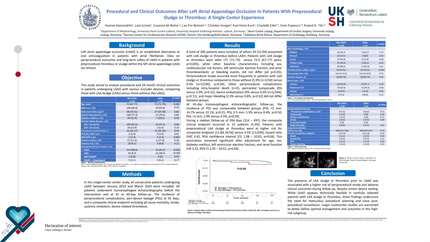
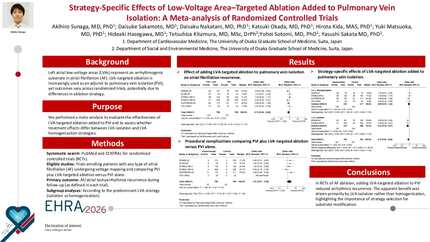
Left atrial appendage isolation in catheter ablation of atrial fibrillation: an updated systematic review and meta-analysis
European Heart Journal


Abstract
Atrial fibrillation is the most encountered arrhythmia in clinical settings, current estimates approach 6 million cases in the United States and the number is expected to go up . A growing amount of evidence has been supporting the role of left atrial appendage in left sided atrial fibrillation, The latest SRMA has investigated 13 RCTs and demonstrated additional benefits for Left atrial appendage ablation . We aim in this systematic review to update the previous SRMA and provide a more in depth guide for optimal left sided atrial fibrillation ablation strategy.
We searched the following databases: PubMed, Web of Science, Cochrane and Scopus for published literature up to May 2024, our main scope was relevant studies that compare the left atrial appendage electrical isolation or ligation in addition to the standard ablation versus the standard ablation alone, our main outcomes were atrial arrhythmia recurrence and the incidence of stroke or transient ischemic attack during the follow-up period, All data were pooled as either Mean difference in the fixed effects model with the corresponding SD or pooled as RR and 95% CI for dichotomous data.
Our systematic review and meta-analysis included 11 studies with 3040 patients, Left atrial appendage electrical isolation in addition to the standard ablation was associated with a significant reduction in atrial arrhythmia recurrence in the follow-up period compared to the standard ablation alone (OR: 0.41, 95%CI [0.35, 0.48]), but it was also associated with a significant increase in stroke or transient ischemic attack incidence in the follow-up period (OR: 1.48, 95%CI [1.09, 3.12]).
left atrial appendage isolation was associated with significant reduction in atrial arrhythmia recurrence, and a significant increase in stroke or transient ischemic attack incidence. Atrial Arrhythmia Recurrence Stroke
Contributors


You may be interested in