10-year trend of antithrombotic therapy status and clinical outcomes of young patients with atrial fibrillation The Fushimi AF Registry
European Heart Journal


Abstract
Atrial fibrillation (AF) is a common disorder in elderly patients and oral anticoagulants (OAC) are recommended to reduce the risk of stroke. On the other hand, AF is relatively rare in young patients and they are thought to be at low risk of stroke. However, AF-related complications are associated with poor clinical outcomes and appropriate anticoagulant therapy in those patients is important. In this decade, direct oral anticoagulants (DOACs) have been prescribed for stroke prevention of AF patients. We already reported that OAC prescription, especially DOAC, has increased in this decade (Akao M et al. Circ J 2022; 86: 726-736). However, temporal trend of OAC prescription of young AF patients in this decade is unknown.
In this study, we investigated the year-to-year change of doses of DOACs from 2011 to 2021 and factors associated with the prescription of OAC and stroke incidence during follow-up period in AF patients under 65 years old by using data of Fushimi AF Registry.
The Fushimi AF Registry, a community-based prospective survey, was designed to enroll all of the AF patients who visited the participating medical institutions in Fushimi-ku, Kyoto, Japan. We started to enroll patients from March 2011 and follow up data including prescription status were available in 4,471 patients from March 2011 to February 2022. Of 4,471 patients, 785 patients were under 65 years old.
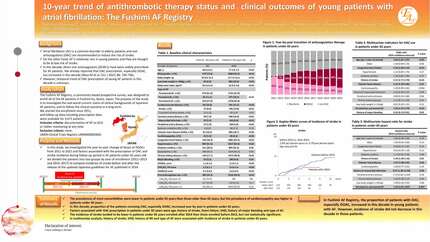
Figure 1 shows year-by-year transition in OAC therapy status from 2011 to 2021. In 2011, 42% of patients received OAC. The proportion of patients prescribed OAC increased year by year and 60% of patients received OAC in 2021. The proportion of patients prescribed DOAC was 2% in 2011 and that increased to 44% in 2021. Then, we divided patients into 3 groups by CHA2DS2-VA score (excluding Sc component) as follows: (1) CHA2DS2-VA score =0; (2) =1; and (3) ≥2. The proportion of patients prescribed OAC were 25%, 42% and 63%, respectively. Factors associated with OAC prescription were age, history of stroke, heart failure, valvular heart disease, history of major bleeding and type of AF. During the median follow-up of 2,571 days, stroke occurred in 49 patients and the rate of incidence of stroke was 1.0% per year. On multivariate analysis, history of stroke, valvular heart disease, history of myocardial infarction and type of AF were significantly associated with incidence of stroke. Finally, we divided the patients into two groups by year of enrollment (2011–2013 and 2014–2017) to compare clinical outcomes before and after the release of the updated Japanese guidelines for AF published in 2014. The rates of incidence of stroke were shown in Figure 2. There was no significant difference between the two groups.
In Fushimi AF Registry, the proportion of patients with OAC, especially DOAC, increased in this decade in young patients. However, incidence of stroke did not decrease in this decade in those patients.
Contributors

K Minami
Author
K Ishigami
Author
K Doi
Author
T Yoshizawa
Author
Y Ide
Author
A Fujino
Author
M Ishii
Author
M Iguchi
Author
M Esato
Author
H Wada
Author
K Hasegawa
Author
M Abe
Author
M Akao
Author
You may be interested in