Interrupted or uninterrupted direct oral anticoagulants for atrial aibrillation ablation which is the best strategy insights from a network meta-analysis
European Heart Journal


Abstract
Direct oral anticoagulants (DOACs), either minimally interrupted (iDOACs) or uninterrupted (uDOACs), are the preferred anticoagulation strategy peri atrial fibrillation (AF) ablation procedure. Direct comparisons of the two regimens are scarce and in small series. A network meta-analysis of iDOACs and uDOACs safety, compared to uninterrupted vitamin K antagonists (uVKA), with a much larger cohort, provides better insight.
To evaluate the thromboembolic and bleeding complications of iDOACs and uDOACs through comparison to uVKA.
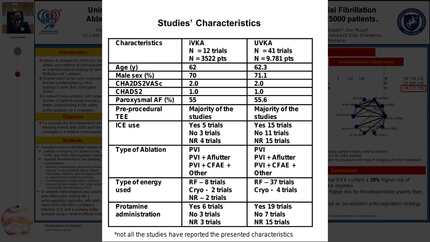
A literature search from 2011 to 2023 identified 47 studies that directly compared bleeding events and thromboembolic events of iDOACs and/or uDOACs to uVKA. A network meta-analysis was used to pool effect sizes amongst the three regimens, which were expressed as odds ratios (OR) with 95% confidence intervals (CI).
The total cohort included 26.060 patients, iDOAC: 5.868; uDOAC: 7.048; uVKA: 13.144 (age 61.2 years, male 72.7 %). Patients on iDOAC had a significantly lower risk of bleeding compared to those on uDOACs in the network analysis ( OR: 0.78, 95% CI: 0.62-0.97) and to uVKA in a direct analysis (OR: 0.72, 95% CI: 0.59–0.86; I² = 42.8%) However, there was no significant difference in bleeding events between uDOAC and uVKA (OR: 0.92, 95% CI: 0.81–1.04; I² = 0.0%) (Figure A, B). There was no difference in thromboembolic events among the three strategies (Figure C, D).
Our findings show that iDOACs strategy has a lower bleeding risk compared to uDOAC and to uVKA regimens, without an increase in thromboembolic complications. These data support the IDOACs as the strategy of choice for periablation anticoagulation. Bleeding complication Thromboembolic complication
Contributors



You may be interested in