Long-term real-world outcomes of edoxaban in atrial fibrillation patients with and without prior ischaemic stroke: A 4-year follow-up analysis from ETNA-AF Europe
European Heart Journal


Abstract
Patients with atrial fibrillation (AF) with a history of ischaemic stroke (IS) or transient ischaemic attack (TIA) exhibit a higher risk of recurrent stroke events. The ETNA-AF-Europe (NCT02944019) four-year follow-up (4yFU) highlighted the long-term safety and effectiveness of edoxaban in patients with AF, showing relatively low rates of death, stroke, major bleeding, and intracranial haemorrhage.
This analysis from the ETNA-AF-Europe 4-year follow-up compares thrombo-embolic and bleeding outcomes with edoxaban in patients with AF with or without a history of IS and TIA, providing insights into their unique risk profile and response to edoxaban.
The ETNA-AF-Europe study was a multicentre, prospective, non-interventional study to evaluate safety and effectiveness of edoxaban in patients with AF across multiple sites in Europe. This analysis summarises baseline characteristics with medical history and 4-year annualised rates, and hazard ratios (HR) of stroke (haemorrhagic, ischaemic, any), TIA, and bleeding (including major bleeding [MB], major gastrointestinal [GI] bleeding, intracranial haemorrhage [ICH], clinically relevant nonmajor bleeding [CRNMB], and any bleeding) in patients with or without IS/TIA history adjusted for age, body weight, creatinine clearance, HAS-BLED score, and CHA2DS2-VASc score. No multiplicity adjustment was made.
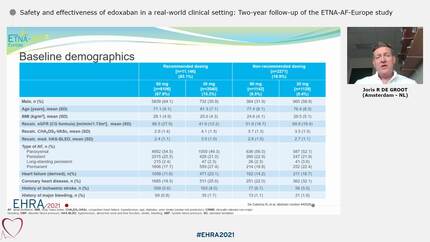
Data from 13,164 patients (1,074 with prior IS/TIA and 12,090 without) from Europe were analysed. Patients with IS/TIA history were older, had a lower mean body weight, body mass index, and creatinine clearance (P<0.0001 for all; Table). Patients with IS/TIA history also had approximately 2 points and 1 point higher baseline stroke (CHA2DS2-VASc) and bleeding (HAS-BLED) risk scores, respectively (P<0.0001 for both; Table) with higher prevalence of all reported cardiovascular comorbidities (Table). When compared with patients without a history of IS/TIA, patients with IS/TIA history had significantly higher annualised rates of IS (1.33% vs 0.41%; HR (95% CI):1.8 (1.2, 2.8) P=0.0083), any stroke (1.56% vs 0.53%;HR (95% CI)=1.9 (1.3, 2.9), P=0.0015), TIA (1.19% vs 0.24%; HR (95% CI)=5.8 (3.4, 10.0), P<0.0001), IS/TIA/systemic embolic event (SEE) (2.38% vs 0.67%; HR (95% CI)=2.5 (1.7, 3.5), P<0.0001), and IS/TIA/SEE/MI (2.92% vs 1.00%;HR (95% CI)=1.9, (1.4, 2.6) P<0.0001). All-cause mortality, cardiovascular mortality, haemorrhagic stroke, MB, major GI bleeding, ICH, CRNMB, and any bleeding did not differ significantly in patients with and without IS/TIA history. Effectiveness and safety outcome hazard ratios are shown in the Figure.
Patients with AF and a history of IS/TIA are at high risk of recurrent cerebrovascular events. While bleeding risks remain unaffected, additional approaches such as addressing comorbidities and exploring rhythm control therapy or left atrial appendage exclusion could further mitigate stroke risk.



You may be interested in