Meta-machine learning for enhanced detection of atrial fibrillation after stroke: FIND-AFDAS
European Heart Journal


Abstract
Atrial fibrillation (AF)-related strokes have a high rate of recurrence and are associated with morbidity, healthcare expenditure, and mortality.(1-3) Accurately identifying patients with stroke at high risk for AF could enable targeted extended monitoring to diagnose AF and prevent recurrent stroke.(4)
To derive a scalable and internationally generalisable prediction model for incident AF after stroke presentation through meta-machine learning.
Candidate variables were selected based on a previous systematic review and logistic regression analysis.(4) We trained and tested logistic regression, random forest, XGBoost, Neural Networks, linear discriminant analysis and Naïve Bayes models in data (partitioned 7:3) from: CPRD (United Kingdom), NTUH (Taiwan), and AF-ESUS (France, Greece). An ensemble learning technique (stacking) was applied to the best performing models from each cohort to develop a meta-model (FIND-AFDAS). External validation was conducted in three international routine EHR cohorts (JMDC Claims Database (Japan), CDARS (China), and PRECISE (Scotland)). Prediction performance and clinical impact was evaluated in the PER DIEM and ARCADIA randomised clinical trial (RCT) populations to estimate the optimum threshold for negative predictive value (NPV), positive predictive value (PPV) and number needed to screen (NNS).
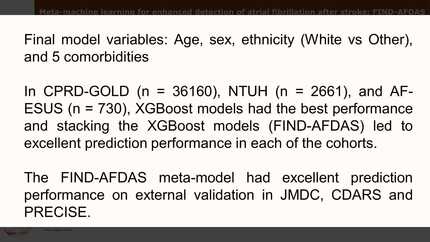
A prior candidate variables selection and logistic regression analysis led to a final parsimonious selection of variables: age, sex, ethnicity (white versus other) and five comorbidities.
In CPRD-GOLD (n = 36160), NTUH (n = 2661), and AF-ESUS (n = 730), XGBoost models had the best performance and stacking the XGBoost models (FIND-AFDAS) led to excellent prediction performance in each of the cohorts (CPRD AUC 0.810, 95% CI 0.795-0.825; NTUH AUC 0.936, 95% CI 0.918-0.953; AF-ESUS AUC 0.967, 95% CI 0.923-0.985) (Table 1). The FIND-AFDAS meta-model had excellent prediction performance on external validation in JMDC (n = 23474, AUC = 0.770, 95% CI = 0.752-787, CDARS n = 3840, AUC = 0.979, 95% CI = 0.947-0.992), and PRECISE (n = 4037, AUC = 0.898, 95% CI 0.878-0.915) (Table 1).
In the PER DIEM RCT population (n=300) of patients with ischaemic stroke or TIA who were randomized 1:1 to implantable loop recorder or external loop recorder, prediction performance of FIND-AFDAS was excellent (AUC 0.981, 0.927-0.995) (Table 1) and an optimised risk threshold of 0.11 led to sensitivity, specificity, PPV, and NPV of 100%, 88,1%, 48.4% and 100%, respectively, and an 80% reduction in NNS (10 to 2) (Figure 1). These excellent results were confirmed in the ARCADIA RCT (n=1005) (Table 1, Figure 1).
The internationally generalisable and scalable FIND-AFDAS meta-machine learning algorithm can accurately identify individuals for extended monitoring for AF after presentation with stroke. Clinical and cost-effectiveness evaluation in a prospective RCT is now required.
Contributors

R Nadarajah
Author
Leeds General Infirmary Leeds , United Kingdom of Great Britain & Northern Ireland

J Wu
Author
K Raveendra
Author
T Joseph
Author
M Haris
Author
Y M Nakao
Author
J C Hsu
Author
G Tse
Author
M Patrik
Author
G Ntaois
Author
A Cameron
Author
Y H Lip
Author
H Kamel
Author
B Buck
Author
C P Gale
Author
You may be interested in