Who missed out on anticoagulation? a nationwide temporal analysis of patients with new-onset atrial fibrillation and no anticoagulation
European Heart Journal


Abstract
Oral anticoagulation (OAC) therapy is the golden standard of ischaemic stroke (IS) prevention for patients with atrial fibrillation (AF) and elevated risk of IS. However, underuse and treatment disparities have been reported.
In this nationwide study, we analysed characteristics, and individual IS risk scores of patients with new-onset AF, who did not initiate any anticoagulation (AC) therapy.
The Finnish AntiCoagulation in Atrial Fibrillation (FinACAF) -study covers all patients with AF in Finland between years 2004 and 2018 at all levels of care. We studied all patients with new-onset AF during years 2011 to 2017 who did not initiate any AC therapy within a year of AF diagnosis. Patients with OAC use before AF diagnosis, and patients deceased within 90 days of AF diagnosis were excluded.
Patient characteristics and comorbidities, as well as CHA2DS2-VA and CHA2DS2-VASc -risk scores for IS are provided.
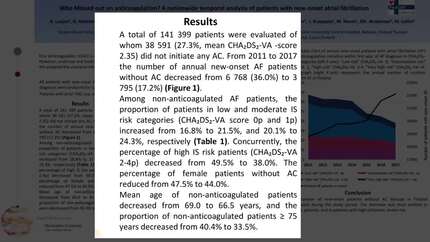
A total of 141 399 patients were evaluated of whom 38 591 (55.3% male, mean CHA2DS2VA-score 2.35) patients did not initiate any AC. From 2011 to 2017 the proportion of new-onset AF patients without any AC decreased from 36.0% (n= 6 768) to 17.2% (n= 3 795) (Figure 1). Among patients without any AC use, small proportional increase from 16.8% to 21.5%, and from 20.1% to 24.3%, were observed in the low and moderate IS risk categories (CHA2DS2-VA score 0p and 1p), respectively. Concurrently, the proportion of patients without AC and high IS risk (CHA2DS2-VA 2-4p) decreased from 49.5% to 38.0%, and the percentage of female patients without AC reduced from 47.5% to 44.0%. Mean age of non-anticoagulated patients decreased from 69.0 to 66.5 years, and proportion of non-anticoagulated patients ≥ 75 years decreased from 40.4% to 33.5%. (Table 1)
The number of new-onset patients without AC therapy decreased during the study period. The decrease was most evident in elderly patients, and in patients with high ischaemic stroke risk.
Figure 1. Stack chart of annual new-onset patients with atrial fibrillation (AF) without anticoagulation initiation within first year of AF diagnosis in CHA2DS2-VA -risk categories (left Y-axis): "Low risk" CHA₂DS₂-VA 0, "Intermediate risk" CHA₂DS₂-VA 1, "High risk" CHA₂DS₂-VA 2-4, "Very high risk" CHA₂DS₂-VA >4. The line graph (right Y-axis) represents the annual number of incident patients with AF in Finland.
Table 1. Patient characteristics of new-onset AF patients in Finland from 2011 to 2017 alive 90 days from cohort entry and no AC initiation within the first year of cohort entry.
Contributors

O Halminen
Author
K Teppo
Author
M Vilpponen
Author
J Haukka
Author
M Linna
Author
P Mustonen
Author
J Putaala
Author
A L Aro
Author

J Kuoppala
Author
M Niemi
Author
M Lehto
Author
You may be interested in