Efficacy and safety of contact force (CF)-guided catheter ablation in atrial fibrillation (AF): an updated systematic review and meta-analysis
European Heart Journal


Abstract
Atrial Fibrillation (AF) is the most common sustained arrhythmia, associated with increased risks of stroke, heart failure, and mortality. Catheter ablation is a well-established treatment for AF, primarily aiming for durable pulmonary vein isolation (PVI). Contact Force (CF)-Guided Catheter Ablation enhances lesion formation by providing real-time force feedback, potentially improving procedural success and reducing complications. While previous studies suggest benefits of CF guidance, an updated meta-analysis is necessary to comprehensively evaluate its efficacy and safety.
This meta-analysis aims to compare AF recurrence rates between CF-guided and non-CF-guided (blinded) catheter ablation. Secondary objectives include assessing vascular access complications associated with CF-guided ablation, evaluating acute success rates (defined as PVI achievement), and analyzing pulmonary vein reconnection rates as a marker of lesion durability.
A systematic review and meta-analysis of randomized controlled trials (RCTs) and observational studies were conducted, including studies that compared CF-guided and non-CF-guided catheter ablation in AF patients. Pooled effect sizes were expressed as relative risk (RR) with 95% confidence intervals (CI), calculated using a random-effects model. Statistical significance was set at p < 0.05. Heterogeneity was assessed using I² statistics, and publication bias was evaluated through funnel plots and Egger’s test.
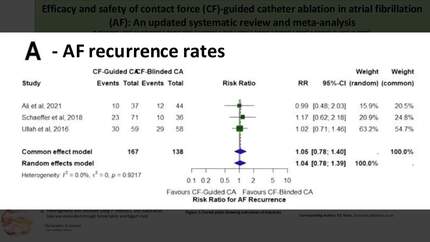
This meta-analysis included four studies with a total of 364 patients, comprising 197 patients in the CF-guided ablation group and 167 patients in the CF-blinded ablation group. The analysis demonstrated no significant difference in AF recurrence rates between CF-guided and CF-blinded ablation (RR 1.04, 95% CI [0.78, 1.39], p = 0.77). Similarly, there was no statistically significant difference in vascular access complications between the two groups (RR 1.24, 95% CI [0.29, 5.37], p = 0.77). The acute success rate, defined as PVI achievement, was comparable between CF-guided and CF-blinded ablation (RR 1.02, 95% CI [0.93, 1.12], p = 0.68). Additionally, pulmonary vein reconnection rates showed a trend favoring CF-guided ablation, but the difference did not reach statistical significance (RR 0.71, 95% CI [0.41, 1.22], p = 0.21).
This meta-analysis suggests that CF-guided catheter ablation does not provide a significant advantage over CF-blinded ablation in terms of AF recurrence, acute procedural success, or vascular access complications. Although there was a trend toward reduced pulmonary vein reconnection with CF-guided ablation, the difference was not statistically significant. These findings highlight the need for larger, high-quality randomized trials to further investigate the potential benefits of CF-guided ablation in improving lesion durability and long-term outcomes in AF patients.
Contributors


M O H D Turzo Rahman
Author
H Eltaly
Author
R Al-Asmar
Author
F Shahid
Author
H Al-Fartosi
Author

A S Ibrahim
Author
You may be interested in