Ganglion plexus ablation during thoracoscopic ablation of advanced af decreases early recurrence during the blanking period: a sub-analysis of the AFACT Trial
European Heart Journal


Abstract
The AFACT study demonstrated that additional ganglionated plexus (GP) ablation in addition to thoracoscopic pulmonary vein isolation in patients with advanced atrial fibrillation (AF) did not significantly reduce late recurrence. However, its impact on early recurrence during the blanking period remains unclear.
This study is a sub-analysis of the AFACT cohort, which randomized 240 patients with advanced paroxysmal or persistent AF to undergo either GP ablation (targeting the four major GPs and the ligament of Marshall) or no GP ablation, in addition to pulmonary vein isolation. Follow-up at 10 days post-discharge was conducted for wound assessment, and symptomatic patients were encouraged to obtain additional rhythm recordings. Early recurrence was defined as AF recurrence within the 3-month blanking period, while late recurrence referred to AF recurrence beyond this period. We also analyzed very early recurrence at 0–12 days and 0–30 days. Cox proportional hazards models were used for risk assessment.
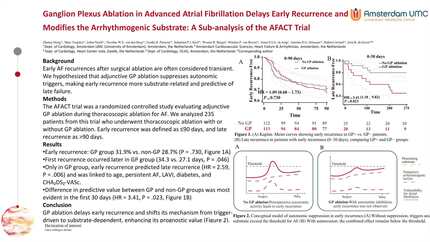
Among 240 patients, the procedure was aborted in 2 patients, and 3 were excluded due to missing recurrence dates, resulting in a total of 235 patients included in the analysis. Among them, 71 experienced early recurrence, with 36 in the GP ablation group and 35 in the non-GP group. Early recurrence occurred in 23.94% (17/71) within the first 12 days, and 63.38% (45/71) within the first month. GP ablation suppressed recurrence within the first 12 days (HR = 0.28, 95% CI: 0.09–0.84, P = 0.02) (Figure 1). However, this effect diminished over time (1 month: HR = 0.82, 95% CI: 0.46–1.48, P = 0.51; 3 months: HR = 1.09, 95% CI: 0.68–1.73, P = 0.73).
In the GP group, persistent AF (HR = 2.69, 95% CI: 1.18–6.15, P = 0.02) and left atrial volume index (LAVI) (HR = 1.02 per 10-ml increase, 95% CI: 1.00–1.04, P = 0.03) were associated with early recurrence, whereas these factors were not significant in the control group.
Among patients who experienced early recurrence within the first month, those in the GP ablation group had a higher risk of late recurrence compared to the control group (HR = 3.41, 95% CI: 1.18–9.82, P = 0.02). However, this association weakened as the early recurrence window extended (0–60 days: HR = 2.22; 0–90 days: HR = 1.69). In contrast, among patients without early recurrence, GP ablation showed a trend of reducing late AF recurrence, but these differences did not reach statistical significance (P > 0.05).
GP ablation predominantly suppresses very early recurrence (≤12 days); however, its effect diminishes over time. Meanwhile, GP ablation significantly increases the risk of late recurrence in patients with early recurrence, particularly within the first month. This suggests that following GP ablation, early recurrence shifts from being trigger-driven (autonomic) to substrate-dependent.
Contributors

M Terpstra
Author
J Neefs
Author
N W E Van Den Berg
Author
F R Piersma
Author
S P J Krul
Author
W R Berger
Author
R Coronel
Author
W P Van Boven
Author
J De Jong
Author
A H G Driessen
Author
J R De Groot
Author
You may be interested in