Repeat ablation outcomes following prior pulsed field ablation using either a circular over-the-wire or pentaspline ablation catheter
European Heart Journal


Abstract
Various pulsed field ablation (PFA) systems have recently become commercially available for pulmonary vein isolation (PVI) in patients with atrial fibrillation (AF). While clinical studies are currently mostly focused on comparing the short-term outcomes of different PFA systems, long-term results remain unknown.
To provide an overview of repeat-ablation findings in patients with recurrent atrial fibrillation after primary ablation with the FARAPULSE or PulseSelect-PFA system.
This analysis is part of a single center, observational registry study including patients with atrial fibrillation undergoing an ablation procedure after January 29th, 2024, at our hospital, the Netherlands. After the ablation procedure, patients were monitored for one year through a remote monitoring program and outpatient clinic visits. For this analysis we selected patients with at least 180 days of follow-up after the index procedure with either the FARAPULSE, pentaspline catheter (FP-group) or the PulseSelect, circular over-the-wire catheter (PS-group). The endpoints included various outcomes of the repeat ablation procedure.
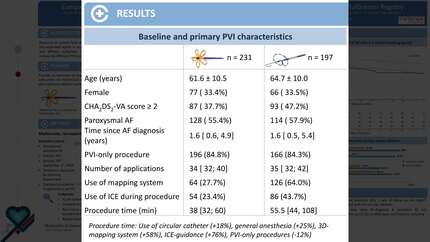
A total of 203 patients were included, of whom 145 were initially treated in the FP-group and 58 in the PS-group. The baseline en procedure characteristics of the index procedures are presented in table 1. Median follow-up time in the FP-group was 322 [252; 350] days vs. 261 [237; 310] days in the PS-group. During this follow-up period 19/145 (13.1%) patients in the FP-group underwent a repeat-ablation due to AF-recurrence, vs. 8/58 (13.8%) of patients in the PS-group.
The outcomes from the repeat ablation procedures are presented in figure 1. In the majority of patients at least one PV was reconnected, and only in 2 patients of the FP-group all PVs were still isolated. In the FP-group the RIPV was most often reconnected, while in the PS-group the LSPV and LIPV were most often reconnected. There were no differences in baseline and procedure characteristics between repeat-ablation patients of the two ablation strategies.
This analysis provides a concise overview of repeat ablation outcomes following initial treatment with two commonly used PFA systems. Due to differences in total follow-up time between the groups and incomplete one-year follow-up, the reported percentage of repeat procedures is likely underestimated.
Contributors




You may be interested in