Procedural outcomes and safety of pulse field ablation using the circular multielectrode array catheter (Pulse Select Catheter) in atrial fibrillation: A real-world prospective study
European Heart Journal


Abstract
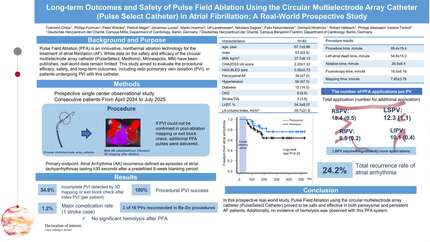
Pulse Field Ablation (PFA) is an innovative, nonthermal ablation technology for the treatment of atrial fibrillation (AF). While data on the safety and efficacy of the circular multielectrode array catheter (PulseSelect, Medtronic, Minneapolis, MN) have been published, real-world data remain limited.. This study aimed to evaluate the procedural efficacy, safety, and outcomes, including redo pulmonary vein isolation (PVI), in patients undergoing PVI with this catheter.
Consecutive patients who underwent first time PVI using the circular multielectrode array catheter were included in this prospective analysis. A three-dimensional electroanatomical reconstruction was performed using the CARTO3 system (J&J) after ablation in sinus rhythm. If PVI could not be confirmed in post-ablation mapping, additional PFA pulses were delivered. Freedom from atrial arrhythmia (AA) was evaluated using 12-lead electrocardiography or 24-hour Holter monitoring. In patients with recurrence and redo ablation, PVI durability was evaluated. Hemolysis related to PFA was assessed using biomarkers, including lactate dehydrogenase, haptoglobin, bilirubin, and reticulocyte count.
A total of 51 patients (mean age 69.3 ± 9.5 years; 39.2% female) with paroxysmal (45.1%) or persistent AF were included in the study. The mean procedural time was 76.1 ± 17.4 minutes, and the mean left atrial dwell time was 60.5 ± 13.2 minutes. The mean ablation time was 30.2±12.5 minutes. Acute PVI was achieved in all patients. The mean number of PFA applications per pulmonary vein was 9.3, with no significant difference in application number among pulmonary veins. Complications occurred in two patients (3.9%), including one stroke within 48 hours post-procedure and one puncture site aneurysm. No pericardial effusion, pulmonary vein stenosis, or phrenic nerve injury was observed. After a mean follow-up of 7.0 months, recurrence of any AA beyond the blanking period was observed in 8 of 38 patients (21.1%), with six (75%) experiencing AF and two (25%) atrial tachycardia (AT). Three patients (two AT, one AF) underwent a second ablation procedure. In both AT cases, PVI was intact, whereas in the AF case, re-PVI was necessary. No significant differences in hemolysis biomarkers were observed before and after PFA.
In this prospective real-world study, Pulse Field Ablation using the circular multielectrode array catheter (PulseSelect Catheter) proved to be safe and effective in both paroxysmal and persistent AF patients. Additionally, no evidence of hemolysis was observed with this PFA system.
Contributors

T Chiba
Author
P H Formum
Author
P Wienke
Author
R Haettasch
Author

P Nagel
Author
T Schreiber
Author
J Lucas
Author


You may be interested in