Colchicine for prevention of pericarditis after catheter ablation: A systematic review and meta-analysis
European Heart Journal


Abstract
Catheter ablation therapy is well established therapy for different types of atrial fibrillation, post ablation pericarditis causes acute chest pain and increases hospital burden, European society of cardiology (ESC) recommends use of colchicine either alone or with NSAIDs for treatment of acute pericarditis, This study aims to establish evidence on the use of colchicine for preventing pericarditis after catheter ablation.
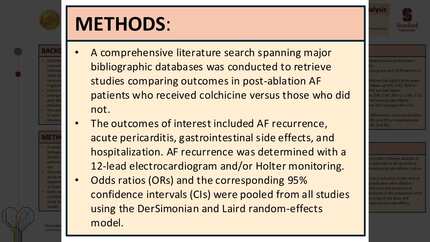
We searched the following 4 databases: Pubmed, Scopus, Web of science and Cochrane until February 2024 for relevant clinical trials and observational studies. Eligible studies were identified and all relevant outcomes were pooled in the meta-analysis random-effects model of the meta-analysis random-effects model of Dersimonia-Liard.
3 results were included with a total of 1419 patients with a higher male percentage and a mean age that ranged from 66 to 69.4 yeras, Colchicine administration before catheter ablation showed a significant decrease in the occurrence of clinical pericarditis after AF ablation, (RR=0.55; 95% CI=0.38, 0.80; p=0.002), Notably, the heterogeneity present (I²=59%,p=0.09) points to variations in study outcomes, The incidence of GI adverse events did not differ substantially between patients treated with Colchicine and those in the control group (OR=1.72; 95% CI=0.23, 12.96; p=0.60). A high degree of heterogeneity (I²=93%,p=0.0001) was observed, No significant difference was observed in the likelihood of hospitalization between the Colchicine and control cohorts (OR=1.01; 95% CI=0.58, 1.76; p=0.98), with minimal heterogeneity (I²=5%,p=0.31) among the included studies. This suggests a consistency in the effect of Colchicine on hospitalization rates across the analyzed studies .
Colchicine was found to be a promising intervention for reducing the incidence of pericarditis following atrial fibrillation ablation, with no effect on pericardial effusion, hospitalization. Despite some contradictory data about gastrointestinal side effects, cautious dosage measures, such as weight-adjusted doses, may improve tolerability while maintaining efficacy in reducing post-ablation problems. Clinical Pericarditis


You may be interested in