Prediction of long-term arrhythmic recurrence and major adverse cardiovascular events using machine learning in patients undergoing catheter ablation for atrial fibrillation: historical cohort study
European Heart Journal


Abstract
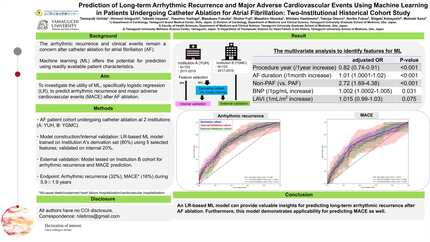
The arrhythmic recurrence and clinical events remain a concern after catheter ablation for atrial fibrillation (AF). Machine learning (ML) offers the potential for prediction using readily available patient characteristics. We investigated the utility of ML, specifically logistic regression (LR), to predict arrhythmic recurrence and major adverse cardiovascular events (MACE) after AF ablation.
We retrospectively analyzed an AF patient cohort undergoing catheter ablation at two institutions A and B. Using the Institution A cohort, multivariate LR selected 5 key features for arrhythmic recurrence from 20 patient characteristics. Subsequently, this cohort was divided into derivation and internal validation sets (80%:20%). An LR-based ML model for predicting arrhythmic recurrence was trained on the derivation set and evaluated on both the internal validation set and an external validation cohort from Institution B. The same ML model was applied to predict major adverse cardiovascular events (MACE), defined as all-cause death, heart failure hospitalization, and other cardiovascular hospitalizations. Performance metrics for arrhythmic recurrence and MACE were assessed.
We included 703 and 153 patients in Institutions A and B, respectively. During 5.9 ± 1.9 years of mean follow-up, 227 (32%) in Institution A experienced arrhythmic recurrence, and 111 (16%) experienced MACE. Procedure year, non-paroxysmal AF, AF duration, brain natriuretic peptide, and left atrial volume index were identified as key features from 20 characteristics. The model for arrhythmic recurrence demonstrated fair performance, with consistent AUCs: 0.708 (derivation), 0.695 (internal validation), and 0.691 (external validation). The same model showed generally applicable performance for MACE prediction, with AUCs of 0.674 (derivation), 0.648 (internal validation), and 0.645 (external validation).
Our data suggest that an LR-based ML model can provide valuable insights for predicting long-term arrhythmic recurrence after AF ablation. Furthermore, this model demonstrates applicability for predicting MACE as well.
Contributors

H Ishiguchi
Author
T Ueyama
Author
Y Yoshiga
Author
M Fukuda
Author
S Fujii
Author
M Hisaoka
Author
S Hashimoto
Author
T Omuro
Author
N Fukue
Author
S Kobayashi
Author
M Sano
Author
You may be interested in