Fluoroless pulsed field ablation for the treatment of atrial fibrillation
European Heart Journal


Abstract
Pulsed field ablation (PFA) is a non-thermal, single-shot pulmonary vein isolation (PVI) technique that provides a safe and effective treatment option for catheter ablation of atrial fibrillation (AF). PVI performed with the most widely used PFA system traditionally been conducted under fluoroscopic guidance. However, a recently introduced software update allows for the use of the electroanatomical mapping (EAM) system to enable a radiation-free (ZF) PFA approach with this system.
The study aimed to compare procedural data between conventional fluoroscopy- guided (non-zero fluoroscopy, NZF) and ZF PFA procedures.
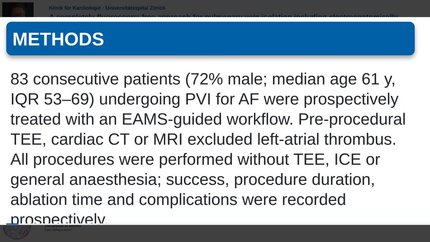
This observational study included 28 consecutive patients who underwent ZF PFA-PVI for AF. As a control group, we analyzed the procedural data of the last 28 consecutive patients who underwent NZF PFA-PVI. The two groups were compared regarding procedural time, radiation exposure, ablation parameters, and complication rates.
In the ZF group, fluoroscopy was completely avoided in all cases, leading to significantly lower fluoroscopy time [0 (0–0) sec vs. 413.5 (327.5–553) sec; p<0.05] and radiation dose [0 (0–0) mGy vs. 15.2 (12.1–19.4) mGy; p<0.05] compared to the NZF group. However, procedural time [42.5 (38–52) min vs. 55.5 (44.5–66) min; p<0.05], time from puncture to first ablation [21 (11–25) min vs. 26 (22.5–30) min; p<0.05], number of applications [36.5 (31–40) vs. 41 (37.5–45); p<0.05], and left atrial dwell time (22.6 ± 11.0 min vs. 36.3 ± 10.8 min; p<0.05) were all significantly shorter in the NZF group compared to the ZF group. No significant difference was observed in the time between the first and last ablation applications [NZF: 24.5 (18.5–30) min vs. ZF: 23 (19–31) min]. One vascular complication occurred in the NZF group.
Radiation-free PFA is a feasible and safe procedure; however, it requires a longer procedural time compared to conventional fluoroscopy-guided PFA.
Contributors


You may be interested in