Unipolar low-voltage in the left atrium, predictors and clinical significance in patients undergoing atrial fibrillation ablation
European Heart Journal


Abstract
Bipolar low-voltage areas (LVA) in the left atrium (LA) are well-known factors influencing the results of atrial fibrillation (AF) catheter ablation. It’s been published recently, however, that bipolar LVA correlate poorly with the fibrosis seen in the magnetic resonance testing, but unipolar LVA in the LA correlate much better. Still, clinical correlates and clinical significance of unipolar testing are not known. The aim of the analysis was to assess clinical predictors and prognostic value of unipolar LVA in patients undergoing AF catheter ablation.
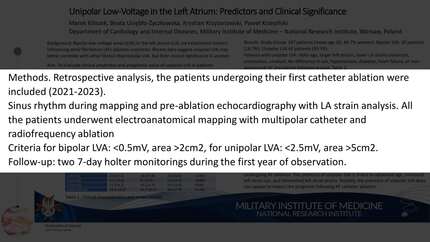
We retrospectively analyzed the patients undergoing their first catheter ablation in the years 2021-2023. Inclusion criteria for analysis: sinus rhythm during electroanatomical mapping and during echocardiography performed before ablation (with LA strains as a part of routine workup). All the patients underwent electroanatomical mapping with a multipolar catheter and radiofrequency ablation. Criteria for bipolar LVA: <0.5mV, area >2cm2, for unipolar LVA: <2.5mV, area >5cm2. The patients underwent routine follow-up with two 7-day holter monitorings during the first year of observation.
A total of 107 patients were included, with a mean age 63.0 years, 35 (40.7%) women. Bipolar LVA had 19 patients (22.1%), while unipolar LVA – 37 patients (43.0%). Major results and characteristics of the study group is shown in Table 1. Patients with unipolar LVA were older, had bigger LA, and lower LA strains (reservoir, contraction and conduit). The distribution of sexes, frequency of hypertension, diabetes, heart failure and non-paroxysmal AF were not different between groups. In the analysis of patients without bipolar LVA, patients with unipolar LVA had lower LASr than those without unipolar LVA (21.0% vs 25.9%, p<0.001). Follow-up was available for 90 patients (84%). Unipolar LVA did not influence the recurrence rate after catheter ablation, while bipolar LVA was significant (Figure 1. AF-free survival analysis log rank test p=0.23 and p=0.03, respectively).
In patients undergoing AF ablation, unipolar LVA are more frequent than bipolar LVA. The presence of unipolar LVA is linked with larger LA and lower LASr. Out of several clinical and demographic parameters, only age was predictive of the presence of unipolar LVA. Unipolar LVA does not seem to affect prognosis after AF catheter ablation.
Contributors

You may be interested in