Extent of myocardial injury after pulmonary vein isolation using three different pulsed-field ablation systems
European Heart Journal


Abstract
Pulsed-field ablation (PFA), a novel non-thermal modality, was recently introduced and is now available with four different FDA approved systems from three different manufacturers. While multiple studies have evaluated individual PFA systems, data comparing different PFA systems are scarce, particularly regarding differences in lesion creation and myocardial injury.
To assess releases of high-sensitivity cardiac Troponin-T (hs-cTnT) after PVI using three different PFA systems to characterize extent of myocardial injury.
The study enrolled consecutive patients undergoing PVI between August 2024 and December 2024 at a Swiss tertiary centre. Hs-cTnT levels were measured one day before and after the procedure. PFA was performed using a pentaspline catheter-system, a loop catheter-system and a variable-loop circular catheter.
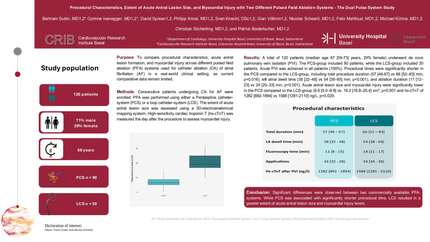
95 patients were treated with PCS (54%), 40 patients with LCS (23%), and 40 patients with VLCC (23%), with a total of 175 patients (median age 68 [60 - 75] years, 33% female). The median CHA2DS2-VA score was 2 [1 - 3], left atrial diameter 40 [36 - 45] mm and left ventricular ejection fraction 59 [53 - 64] %. The standard PFA application protocols were followed. The number of applications per patient for PCS, LCS and VLCC PFA system were 34, 34, and 54 (18 ablations), respectively. Pre-interventional median hs-cTnT levels did not differ between the three groups (10 [7 – 15], p=0.948 ng/L). Post-interventional median hs-cTnT levels were considerably higher in the PCS (1672 [1180 - 2188] ng/L) and LCS group (1740 [1364 - 2289] ng/L; p=0.563) compared to the VLCC group (708 [471 - 1213] ng/L; p<0.001, Figure).
In conclusion, we found that the VLCC system is associated with significantly lower myocardial injury compared to PCS and LCS. Further prospective studies are needed to determine whether this difference in myocardial injury corresponds to improved lesion durability and long-term clinical outcomes.
Contributors


C Isenegger
Author
M Koechlin
Author
S Knecht
Author
B Subin
Author
D Spreen
Author
N Schaerli
Author
P Krisai
Author
F Mahfoud
Author
C Sticherling
Author
M Kuehne
Author
P Badertscher
Author
You may be interested in