Efficacy and safety of a ketamine-based sedation protocol for atrial fibrillation ablation with pulsed field energy: a single-center retrospective experience
European Heart Journal


Abstract
Catheter ablation (CA) with pulmonary vein isolation (PVI) is a well-recognized therapeutic strategy for the treatment of atrial fibrillation (AF). Pulsed-field ablation (PFA) allows for greater myocardial selectivity and reduces delivery time compared to conventional thermal energies. However, its diffusion remains partly limited by the need of deep sedation or general anesthesia protocols for intraprocedural pain management, and often requires active anesthesiologic support.
To evaluate the efficacy and safety of a ketamine-based sedation protocol in spontaneous respiration, directly managed by electrophysiologists with the help of trained nurses, without any active anesthesiologic support.
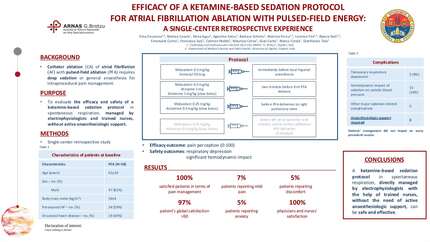
We conducted a single-center retrospective observational study on a cohort of consecutive patients undergoing CA of AF with PFA during 2024, managed with a ketamine-based sedation protocol (Table 1 and 2). The efficacy outcome was pain perception, evaluated through a numerical rating scale (0-100), assessed by a questionnaire administered up to 24 hours after CA. Levels of anxiety and discomfort during procedure were simultaneously tested, and both nurses’ and electrophysiologists’ satisfaction was collected. The safety outcomes were respiratory depression (defined as a reduction in oxygen saturation below 90%), and significant hemodynamic impact (i.e. at least one systolic blood pressure [SBP] determination >180 or < 80 mmHg or a rise or fall in SBP >40 mmHg from baseline).
A total of 58 patients were enrolled (mean age 61±10 years, mean BMI 26±4 kg/m2, 81% males, 59% paroxysmal AF, 34% structural heart disease). The mean procedural time was 127±49 minutes. All patients reported to be enough satisfied in terms of pain management (100%). Four patients (7%) described mild pain (≤20/100), mainly related to vascular access. Some degree of anxiety and discomfort was reported by 4 (7%) and 3 (5%) patients, respectively. The global satisfaction about sedation protocol was ranked above 90/100 by 56 patients (97%). Physicians and nurses were all completely satisfied, and patients’ management didn’t impact on acute procedural success.
Temporary respiratory depression occurred in 5 patients (9%), and it was promptly managed by basic opening airway maneuvers and oxygen delivery through facial mask. Hemodynamic impact of sedation protocol on SBP was documented in 15 patients (26%), and easily resolved with fluid challenge, or ephedrine administration. No other major sedation-related complications were reported, and no call for anesthesiologic support was required.
Data from this single-center retrospective analysis show that a ketamine-based sedation protocol with spontaneous respiration directly managed by electrophysiologists with the help of trained nurses without the need of active anesthesiologic support can be safe and effective, potentially facilitating the diffusion of PFA for AF ablation.


You may be interested in