Impact of activation direction on omnipolar voltage and peak frequency
European Heart Journal


Abstract
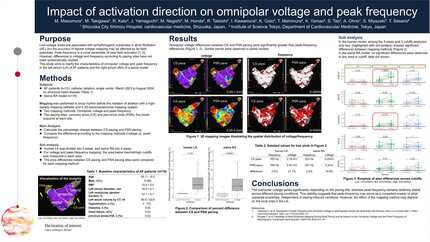
Low-voltage areas are strongly associated with arrhythmic substrates in atrial fibrillation (AF). Another parameter, peak frequency, reflecting electrogram sharpness, has been introduced as a novel marker to focus on near-field activation. A combination of these parameters may be important to show the arrhythmogenic substrates, but the impact of activation direction on these parameters has not been systematically examined.
This study aims to investigate the impact of omnipolar voltage and peak-frequency in left atrium (LA) of AF patients, and right atrium (RA) in healthy animal model during pacing from two distinct atrial sites.
A total of 10 AF patients and 16 healthy animals were included in this study. In each patient and animal, 3D-anatomical maps were composed during coronary sinus (CS) pacing and peri-sinus node (PSN) pacing. At each site, five beats were acquired during CS-pacing and PSN-pacing before moving the catheter to the subsequent sites. Both omnipolar voltage and peak-frequency during CS-pacing and PSN-pacing were compared.
The AF patients included in the analysis had a mean age of 65.1 ±13.1years, 90% were male, and LA volume was 95.5±52.9 ml. None had structural heart disease. The mean omnipolar voltage was 2.18 mV during CS pacing and 2.43 mV during PSN pacing, with an average difference of 21.1% between the two sites. The mean peak-frequency was 353 Hz during CS pacing and 348 Hz during PSN pacing, showing a 3.5% change on average. The average difference between the pacing sites in omnipolar voltage was significantly greater than that of peak-frequency (p<0.001). A similar significant difference was observed in the animal RA, with the average difference between the pacing sites being 14.8% for omnipolar voltage and 2.2% for peak-frequency (p<0.001).
The omnipolar voltage varied significantly depending on the pacing sites, whereas peak-frequency remained relatively stable across different pacing conditions. This stability in peak-frequency offers novel insights as a consistent marker of atrial substrate properties, independent of pacing-induced variations.
Contributors

M Takigawa
Author
R Kato
Author
J Yamaguchi
Author
M Negishi
Author
M Honda
Author
R Tateishi
Author
I Kawamura
Author
K Goto
Author
T Nishimura
Author
K Yamao
Author
S Tao
Author
A Ohno
Author
S Miyazaki
Author
T Sasano
Author
You may be interested in