Significance of pulmonary vein reconnections and extra-pulmonary vein procedures in repeated atrial fibrillation ablation
European Heart Journal


Abstract
Recent technologies improved pulmonary vein (PV) isolation (PVI) durability whereas PV reconnection (PVr) and recurrence of atrial fibrillation (AF) are still important issues.
Patients who underwent 2nd ablations for AF between 2019 and 2023 were classified into 2 groups: PVr positive, and negative group. One hundred and ninety-nine cases (65% men, 69 yo, 41% paroxysmal) were retrospectively analyzed.
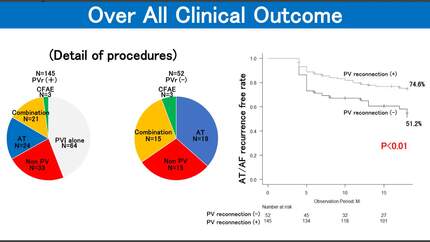
PVr was observed in 145 cases (73%, 2.3±1.1 PVs/patient). Extra-PV procedures were performed based on induction tests; non-PV trigger ablation in 74 (37%), atrial tachycardia (AT) ablation (line or focal) in 81 (41%), and defragmentation ablation in 17 (9%). In the PVr positive group (N=145), re-PVI alone was most prevalent (N=64, 44.1%), followed by non-PV trigger ablation (N=33, 22.8%). In the PVr negative group (N=52), AT ablation was most prevalent (N=19, 36.5%), followed by non-PV trigger ablation (N=15, 28.8%) (Fig). After 14±5 months of follow-up, AT/AF recurrence free rate in the PVr positive group was significantly higher compared with PVr negative group (74.6% vs 51.2%, P<0.01, Fig). AT ablation (including cavo-tricuspid isthmus) in addition to re-PVI achieved favorable outcomes in the PVr positive group (Fig). However, cases requiring other extra PVI procedures were associated with poorer outcomes both in PVr positive and negative groups (Fig).
Re-PVI is still the main targets for recurrent AF and patients with AF recurrence without PVr has poorer AF free rate even after 2nd procedures.


You may be interested in