Impact of ablation modality on alternative efficacy endpoint definition of pulmonary vein isolation for atrial fibrillation
European Heart Journal


Abstract
Pulsed-field ablation (PFA) is an innovative interventional therapy for atrial fibrillation (AF) that offers selective myocardial tissue ablation and a distinct safety profile. Previous studies showed similar efficacy for PFA when compared to thermal ablation modalities such as cryoballoon ablation (CBA) and radiofrequency ablation (RFA) using the current definition for recurrence after AF ablation. Little is known regarding the impact of the ablation modality on alternative efficacy endpoint definition.
Consecutive patients undergoing first-time pulmonary vein isolation (PVI) for AF using PFA, CBA or RFA without additional lesions (PVI only approach) were enrolled and prospectively followed up for at least 365 days. An alternative efficacy endpoint was used, defined as a) clinical success: no atrial arrhythmia lasting >30s during a follow-up of 365 days or b) durably isolated pulmonary veins (PV): no reconnected PV during the first invasive redo-procedure.
A total of 1885 (median [IQR] age, 64 [56, 70] years; 556 females [29.4%]) patients who underwent their first PVI for AF and had complete 365 days follow-up data available, were included in the analysis. 178 Patients underwent PFA (9%), 527 CBA (28%) and 1180 RFA (63%). Proportion of female patients was comparable between PFA and the other modalities (PFA 31% [n=55]; CBA 28% [n=148]; RFA 30% [n=353]; PFA vs CBA p=.534, PFA vs RFA p=0.858), while left atrial volume index was similar with 38.0 [± 11.0] ml/m2, 35.8 [±12.0] ml/m2 and 37.5 [±13.1] ml/m2 for PFA, CBA and RFA, respectively, (PFA vs CBA p=.051, PFA vs RFA p=0.634).
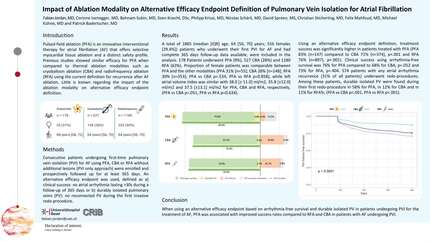
Using an alternative efficacy endpoint definition, treatment success was significantly higher in patients treated with PFA (PFA 83% (n=147) compared to CBA 71% (n=374), p<.001 and RFA 76% (n=897), p<.001). Clinical success using arrhythmia-free survival was 76% for PFA compared to 68% for CBA, p=.052 and 73% for RFA, p=.404. 574 patients with any atrial arrhythmia recurrence (31% of all patients) underwent redo-procedures. Among these patients, durable isolated PV were found during their first redo-procedure in 58% for PFA, in 12% for CBA and in 11% for RFA%; (PFA vs CBA p<.001, PFA vs RFA p<.001).
When using an alternative efficacy endpoint based on arrhythmia-free survival and durable isolated PV in patients undergoing PVI for the treatment of AF, PFA was associated with improved success rates compared to RFA and CBA in patients with AF undergoing PVI. Graphical Abstract
Contributors



You may be interested in