Catheter ablation versus antiarrhythmic drugs in patients with ventricular tachycardia and ischemic cardiomyopathy: a meta-analysis of randomized controlled trials
European Heart Journal


Abstract
Ventricular tachycardia (VT) significantly contributes to mortality in ischemic cardiomyopathy. However, the choice between catheter ablation and anti-arrhythmic drugs in the management of VT episodes remains challenging.Purpose: This systematic review and meta-analysis aims to evaluate the comparative efficacy and safety between catheter ablation (CA) and antiarrhythmic drugs (AAD) in patients with VT and ischemic cardiomyopathy (ICM).
We systematically searched PubMed, Embase and Cochrane for randomized controlled trials (RCTs) that compared the efficacy and safety between catheter ablation (CA) and antiarrhythmic drugs (AAD) in patients with VT and ischemic cardiomyopathy (ICM). Primary outcome was a composite of death from any cause during follow-up, appropriate ICD shocks, ventricular tachycardia storm, or hospitalizations for cardiac issues. The secondary outcomes were: death from any cause during follow-up or after 14 days following randomization, appropriate ICD shock, VT storm and hospitalizations for cardiac issues. We compared the results using Risk Ratio (RR) under a random effects model with 95% Confidence Intervals (CI), and p-value < 0.05 was considered for statistical significance.
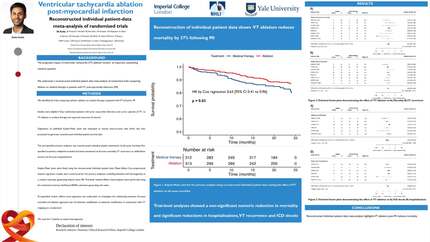
A total of 4 RCTs were included, comprising 866 patients, of which 429 were allocated to the CA group. Approximately 85.3% were male, with a mean age ranging from 67 to 70 years and a follow-up ranging from 24 to 51.6. Catheter ablation was associated with a risk reduction of the incidence of the primary outcome (RR 0.78; 95% CI 0.62–0.98; p = 0.032; I²=56%, Figure 1.A). There were not statistically significantly different between CA and AAD regarding death (RR 0.87; 95% CI 0.56–1.36; p = 0.13; I² = 50%, Figure 1.B), hospitalization for cardiac issues (RR 0.85; 95% CI 0.43–1.68; p = 0.643; I² = 47%, Figure 2.C), VT storm after treatment (RR 0.82; 95% CI 0.63–1.07; p = 0.144; I² = 0%, Figure 2.E) and appropriate ICD shocks after treatment (RR 0.82; CI 0.63–1.07; p=0.46; I²=0%, Figure 2.D).
This systematic review and meta-analysis of RCTs comparing CA vs AAD treatment in patients with RV and ischemic cardiomyopathy showed a reduced risk of the composite outcome of death from any cause, appropriate ICD shocks, ventricular tachycardia storm, or hospitalizations for cardiac issues. Although these findings reinforce the relevance of ablation as a viable alternative for VT, limitations such as the short follow-up of the studies and the heterogeneity of the results indicate the need for more robust RCTs, with larger samples and longer duration, to evaluate long-term outcomes and improve the management of these patients. -Primary Outcome and death - Hospitalization, ICD, VT storm
Contributors

M Sobral
Author
M Hirosse
Author
R Machado
Author
M Vieira Cota
Author
R Rodrigues
Author
K Ogasawara Donato
Author
M Nepomuceno Fernandes
Author


C Guida
Author
You may be interested in