Selecting patients for targeted therapy with early rhythm control using BMP10 blood biomarker levels
European Heart Journal


Abstract
Atrial fibrillation is a major risk factor for stroke, worsening of heart failure, acute coronary syndrome (ACS), and cardiovascular death. Early rhythm control (ERC) reduced major complications of atrial fibrillation in the EAST AFNET 4 trial. The concentrations of selected cardiovascular biomolecules identify patients at high and low risk for experiencing complications independent of the treatment. Whether these biomolecules can help to select patients for rhythm control is not known.
This secondary analysis of the EAST-AFNET 4 trial studied interactions between patient subgroups defined by biomolecule concentrations and the treatment effects of ERC.
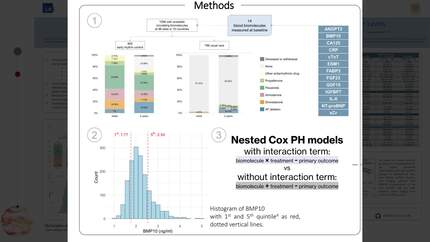
In the EAST-AFNET 4 biomolecule study (n=1586, median age 70 years, 45% women), the biomolecules angiopoietin 2 (ANGPT2), bone morphogenetic protein 10 (BMP10), cancer antigen 125 (CA125), C-reactive protein (CRP), endothelial specific molecule 1 (ESM1), fatty acid binding protein 3 (FABP3), fibroblast growth factor 23 (FGF23), growth differentiation factor 15 (GDF15), insulin-like growth factor binding protein 7 (IGFBP7), interleukin-6 (IL-6), N-terminal pro–B-type natriuretic peptide (NT-proBNP), cardiac troponin (TnT), and serum creatinine (sCr), were quantified at baseline. Patients were categorized into quintiles based on biomolecule concentrations, followed by assignment to low (lowest quintile), medium (middle three quintiles), and high (upper quintile) concentration groups after natural log-transformation and 1% upper winsorization of each biomolecule. Cox proportional hazard models examined primary outcomes over a median follow-up of 4.8 years, including the study centre as a frailty term and interaction terms between biomarkers and treatment type (usual care vs. ERC). Models were adjusted for sex, age, and heart rhythm at blood draw.
Only BMP10 concentrations showed significant interaction with ERC (p-interaction=0.03). No other tested biomolecule showed similar interactions (p-interaction=0.95-0.07). Patients with medium BMP10 concentrations (median 2.11 interquartile range (IQR) 1.96-2.28 ng/ml) showed a benefit from ERC (hazard ratio (HR) 0.55, 95% CI 0.41-0.75, p<0.001). High BMP10 concentrations (median 2.89 IQR 2.68-3.18 ng/ml) showed a trend toward treatment effect (HR 0.71, 95% CI 0.45-1.12, p=0.138). Patients with low BMP10 concentrations (median 1.62 IQR 1.51 - 1.70 ng/ml) did not benefit from ERC (HR 1.41, 95% CI 0.73-2.72, p=0.308) and events were lower in usual care in patients with the lowest BMP10 concentrations (figure 1). Patient characteristics are shown in table 1.
These findings suggest that low BMP10 concentrations may identify AF patients for whom rhythm therapy is not immediately necessary. Further validation studies are required to confirm these results. Event Free Survival Probability by BMP10 Clinical Characteristics
Contributors


J Obergassel
Author
K Borof
Author
A Rillig
Author
A Metzner
Author
A Goette
Author
C Magnussen
Author
M Sinner
Author
T Zeller
Author
R Schnabel
Author
U S Schotten
Author
A Zapf
Author
P Kirchhof
Author
L Fabritz
Author
You may be interested in