A multicenter analysis of atrial fibrillation burden reduction with antiarrhythmic drugs in patients with cardiac implantable electronic devices
European Heart Journal


Abstract
Time to recurrent atrial fibrillation (AF) is the accepted efficacy measure of rhythm control interventions, yet reduction in AF burden is increasingly recognized as a clinically important endpoint. To date, there are limited data on changes in AF burden after anti-arrhythmic drug (AAD) initiation.
To evaluate changes in AF burden after AAD initiation in patients with cardiac implantable electronic devices (CIEDs) capable of continuous, highly sensitive arrhythmia monitoring.
We conducted a retrospective study of all CIED patients from two academic hospitals with new AAD initiation between 4/2018-3/2022 who did not undergo electrical cardioversion or catheter ablation during this monitoring period. We quantified AF burden in CIED patients at up to 6 months pre- and 12 months post-AAD initiation. Analyses assessed changes in AF burden among patients with AF >30 seconds after AAD initiation.
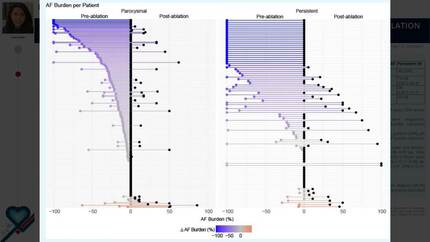
There were 128 patients (73.6±12.2 years, 61% male) with AF burden data both pre- and post-AAD initiation included in analysis. Average time to the first AF quantification post-AAD initiation was 5.0±6.8 months, and 98 patients had >1 post-AAD AF measurement (average time to final AF quantification: 9.6±7.6 months). There was a significant reduction in AF burden in both the first and final CIED interrogations post-AAD initiation compared to pre-AAD AF burden (pre 5.9% [IQR 1.3-29.7%], first post 0.2% [IQR 0-2.9%], final 0.1% [IQR 0-1.5%]). The median AF burden reduction at first post interrogation was 90.5% [IQR 2.7-100%] and the median AF burden reduction at the final interrogation was 97.4% [IQR 35.7-100%]. A significant reduction in AF burden was seen at both timepoints in patient subgroups taking amiodarone (pre 6.4% [IQR 1-36%], first post 0.1% [IQR 0-1.5%], final 0.1% [IQR 0-1.1%]), non-amiodarone AADs (pre 5% [IQR 1.5-21.5%], first post 1% [IQR 0-5%], final 0.1% [IQR 0-2.9%]), and high baseline AF burden (≥90%) (pre 100% [IQR 99.9-100%], first post 0.1% [IQR 0-71.1%], final 0.1% [IQR 0-59.7%]) and low baseline AF burden (≤20%) (pre 2.2% [IQR 0.8-6.1%], first post 0.1% [IQR 0-1%], final 0.1% [IQR 0-0.9%]) (p-value for all <0.05). Among those with AF >30 seconds after AAD initiation, median reduction in AF burden was 72.1% [IQR 5.3-96.9%] at the final CIED interrogation.
There was a median 97.4% [IQR 35.7-100%] reduction in AF burden following AAD initiation in CIED patients through the final interrogation. Results are consistent in subgroups based on AAD type and baseline AF burden. Atrial Fibrillation Burden over Time


You may be interested in