Impact of cardiac damage on cardioversion success in patients with atrial fibrillation and heart failure with preserved ejection fraction
European Heart Journal


Abstract
The extent of cardiac damage and its association with clinical outcomes in heart failure patients with preserved ejection fraction (HFpEF) undergoing cardioversion for atrial fibrillation remains unclear. In this study, we investigated the distribution and prognostic relevance of different stages of cardiac damage in HFpEF patients undergoing cardioversion for atrial fibrillation.
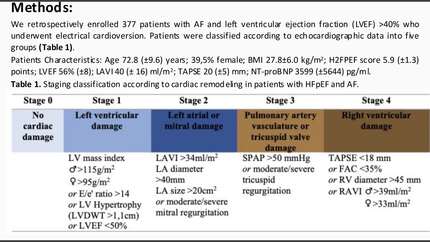
The clinical, echocardiographic and outcome data of patients with atrial fibrillation and left ventricular ejection fraction (LVEF) >40% who underwent cardioversion were analyzed retrospectively. According to the extent of cardiac damage on echocardiography, patients were classified into 5 groups: No cardiac damage (stage 0), left ventricular damage (stage I), mitral valve or left atrial damage (stage II), tricuspid valve or pulmonary artery vasculature damage (stage III), right ventricular damage (stage IV). Patients were stratified in two groups: early cardiac damage (stage 0-II); late cardiac damage (stage III/IV). Cardioversion success, all-cause mortality, hospitalization for heart failure and atrial arrhythmia recurrence were analyzed during one-year follow up.
Five hundred sixty-six patients (mean age 76.7 ± 10.6 years; female 39.6%; mean LVEF 56.15 ± 7.90%) were included. Forty-five patients (8.0%) were classified in stage 0, 59 patients (10.4%) in stage I, 175 patients (30.9%) in stage II, 71 patients (12.5%) in stage III and 216 patients (38.2%) in stage IV. Late cardiac damage (stage III/IV) was associated with lower cardioversion success compared to early stages (stage 0-II) (late vs. early cardiac damage: 84% vs. 91%; p=0.0141) (Figure 1). Similarly, all-cause mortality and HF hospitalization rates were increased in patients with late cardiac damage (late vs. early cardiac damage: 34% vs. 15%; p<0.001). However, with advanced cardiac damage, the probability of recurrence of arrhythmias was not significantly increased (late vs. early cardiac damage: 44% vs. 38%; p=0.338).
HFpEF patients with advanced cardiac damage (stage III/IV) showed reduced cardioversion success as well as increased HF hospitalization and all-cause mortality rates during follow-up compared with patients with none or less cardiac damage (stage 0-II). Thus, it should be investigated, whether an early catheter ablation improves outcomes and delays the progression of cardiac damage.
Contributors

N Gunther
Author
S Angendohr
Author
V Varneckaite
Author
L Christian
Author
P Leuders
Author
J Glasmacher
Author
J Haurand
Author
E Zweck
Author
F Voss
Author
A Bejinariu
Author
A Polzin
Author
M Kelm
Author
O Rana
Author
M Spieker
Author
You may be interested in