Intravenous vagal stimulation catheter induces rapid heart rate reduction without hemodynamic compromise in a dog model of atrial fibrillation with severe tachycardia
European Heart Journal


Abstract
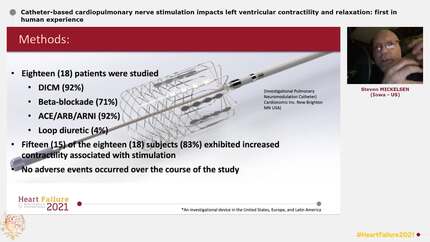
Appropriate heart rate (HR) control is challenging in heart failure patients with atrial fibrillation (AF) or tachycardia due to the negative inotropic effect of most bradycardic agents. Parasympathetic nervous system is the primary determinant of HR for quick control of hemodynamic homeostasis. We have developed a basket-shaped catheter for intravenous vagal nerve stimulation (iVNS) which directly modulates the parasympathetic nervous system.
This study aimed to evaluate the impact of iVNS catheter on HR, hemodynamics and cardiac metabolism in a canine model with AF tachycardia.
We used six beagle dogs (10.8 ± 0.6 kg), inserted iVNS catheter from femoral vein, and placed it in superior vena cava. We induced AF with atrial high-frequency stimulation (20Hz) under isoproterenol administration, and applied iVNS at 10–20 V (20 Hz) for 3-min. We simultaneously recorded electrocardiogram, arterial pressure (AP) and cardiac output (CO) and calculated myocardial oxygen consumption (MVO₂) from oxygen saturation of coronary sinus and artery and coronary flow. We compared HR, hemodynamics, and MVO₂ between baseline and during iVNS.
The iVNS decreased HR immediately after the onset of stimulation and HR promptly returned to baseline as soon as the stimulation is discontinued. While iVNS significantly reduced HR (baseline: 237.5±47.8 vs. iVNS: 213.7±41.0 bpm, p<0.01), while did not change mean AP (57.4±13.8 vs. 57.7±13.2 mmHg, p=0.23) and cardiac output (1.57±0.58 vs. 1.56±0.68 ml/min, p=0.87). The iVNS tended to decrease MVO₂ but statistically not significant in this limited cohort (4.86±2.86 vs. 4.11±2.18 ml/100g LV weight, p=0.11).
iVNS rapidly decreased HR in a canine model with AF tachycardia, and HR immediately returned to baseline without hemodynamic collapse in when simulation was discontinued. It has a potential to develop an alternative treatment for AF tachycardia, especially unstable hemodynamic condition. The effects of iVNS on HR, AP and CO. Hemodynamic and myocardial oxygen consum
Contributors

K Sakamoto
Author
H Morita
Author
M Otake
Author
N Hiraki
Author
K Sato
Author
H Yokoyama
Author
T Nagayama
Author
S Takase
Author
K Saku
Author
K Abe
Author
You may be interested in