Improving management of patients with atrial fibrillation in the emergency department based on an aggressive rhythm control strategy. The HEROMEDICUS study
European Heart Journal


Abstract
Atrial fibrillation (AF) accounts for 1-2% of emergency department (ED) visits to a general hospital, of which 60% are admitted. The lack of concrete guidelines justifies the use of a more conservative rather than a more aggressive strategy.
In this context, we created the "HEROMEDICUS" study for the management of these patients in the acute phase. The protocol includes an aggressive electrophysiologist-guided rhythm control strategy for patients presenting with AF in the ED.
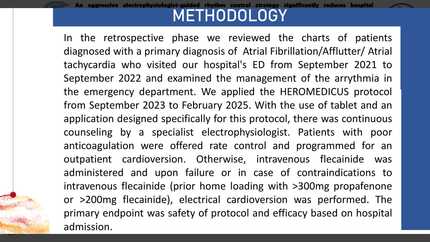
All patients who visited the ED from September 2023 to February 2025 due to AF or atrial flutter were tested for possible inclusion in the protocol. Patients with acute coronary syndrome or heart failure were excluded. With the use of tablet and an application designed specifically for this protocol, there was continuous counseling by a specialist electrophysiologist. Patients with poor anticoagulation were offered rate control (verapamil on atrial tachycardia and beta-blockers on atrial fibrillation) and programmed for an outpatient cardioversion. Otherwise, intravenous flecainide was administered and upon failure or in case of contraindications to intravenous flecainide (prior home loading with >300mg propafenone or >200mg flecainide), electrical cardioversion was performed with the patient fasting for 6 hours and with sedation and analgesia administration (midazolam IV & analgesia IV). The primary endpoint was safety of protocol and efficacy based on hospital admission.
From the period 08/09/2023 to 25/02/2025, 215 cases visited our ED, of which 11 had atrial tachycardia, 16 had atrial flutter and 188 had atrial fibrillation. Mean age was 71.3±5.7 years (53% female) and 95 patients had their first episode of arrhythmia. Mean CHA2DS2-VA score was 2.2 ±0.1 and the mean ventricular frequency was 120±3.5bpm. 43% was on prior anticoagulant medication.
Rate control was performed in 20% with beta-blockers and verapamil. Spontaneous cardioversion happened in 12%. Successful cardioversion to sinus rhythm with intravenous flecainide was performed in 48 of 68 patients (70.5%) while in 87 of 91 patients electrical cardioversion was successful. A total of 75% of patients had sinus rhythm after evaluation and admission took place in 4.1% of cases. An adverse event (allergy to administered medicines) was reported in 0.4% of patients.
Aggressive rhythm control strategy through implementation of the HEROMEDICUS protocol in the ED showed that 75% of the study population reverted to sinus rhythm and admissions were limited to 4.1%, without compromising safety.
Contributors


D Tsiachris
Author
A Laina
Author
A E Karanikola
Author
M Botis
Author
I Kachrimanidis
Author
F Tatakis
Author
P Tsioufis
Author
M Kouremeti
Author
C Kalantzis
Author
A Kordalis
Author
K Tsioufis
Author
You may be interested in