Prediction of early atrial fibrillation using artificial intelligence from a single-lead ECG in screening
European Heart Journal


Abstract
One-third of atrial fibrillation (AF) cases remain asymptomatic, undiagnosed, and hence untreated. These patients have a significantly increased risk for stroke and cardiovascular complications. Recent advancements in artificial intelligence (AI), especially convolutional neural networks (CNN), suggest that AI could be used to increase AF detection in AF screening.
This project aimed to create an AI model that accurately predicts which patients will exhibit paroxysmal AF within two to four weeks based on single-lead electrocardiogram (ECG) recording in sinus rhythm.
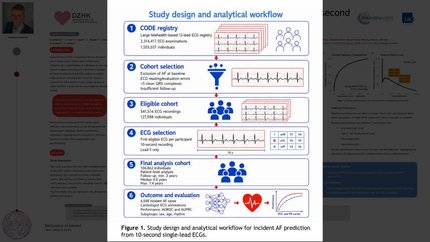
ECG data from four large prospective AF screening studies (STROKESTOP I, STROKESTOP II, SAFER Feasibility, and SAFER Trial) were used to develop the algorithm. Patients were instructed to record a single-lead ECG for 30 seconds using a Zenicor device two to four times per day over two to four weeks across the different studies. The ECG data was preprocessed using the Cardiolund ECG parser, which standardizes the signal and applies bandfiltering to remove noise. The CNN model was developed in two phases: pre-training to learn core ECG attributes and training to predict AF likelihood from sinus rhythm recordings. Approximately 80% of the AF ECG data chosen randomly was used to train the model, and the remaining 20% was used to evaluate the model’s performance.
In total, 142 439 single-lead ECGs from 6 378 patients were used to train the model. The patients were aged ≥ 65 years old with a majority of patients being ≥ 70 years old. The model was tested on the remaning patients, totaling 449 500 ECGs from 14 961 patients. Performance varied with age, with an AUC performance of 83.8 based only on the initial ECG among individuals aged ≥78 in the SAFER Trial. Overall, the AI model achieved an area under curve (AUC) of 80.0 across all studies and a specificity of 65.5 at 75% sensitivity based only on the first ECG. The model achieved an AUC performance ranging from 83.8 to 73.2 across the different studies based only on the initial ECG. Performance was similar when including all ECG recordings during sinus rhythm, with an AUC of 86.9-70.7. Performance was highest in SAFER feasibility, where the model achieved an AUC of 86.9.
An artificial intelligence model can accurately predict early atrial fibrillation, especially in an elderly population, based on a single-lead ECG recording in sinus rhythm, facilitating screening.
Contributors


You may be interested in