Comprehensive assessment of novel biomarkers in atrial fibrillation
European Heart Journal


Abstract
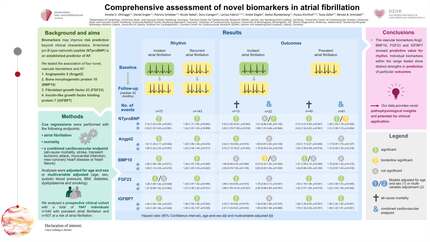
Biomarkers have the potential to improve risk prediction beyond clinical characteristics. We examined the association of four emerging vascular biomarkers (Angiopoetin 2 [Ang2], bone morphogenetic protein 10 [BMP10], fibroblast growth factor 23 [FGF23], insulin-like growth factor binding protein 7 [IGFBP7]) and N-terminal pro brain-natriuretic peptide (NT-proBNP) in relation to atrial fibrillation (AF) and its outcomes.
We enrolled patients from a prospective clinical cohort of patients with AF or at high risk of AF. Prevalent AF was defined as a diagnosis of AF at baseline, incident AF as the occurrence of new AF during follow-up, recurrent AF as prevalent AF with AF events during follow-up. Ang2, BMP10, FGF23, IGFBP7 and NT-proBNP were quantified using high-throughput, high-precision precommercial assays (Roche Diagnostics). A combined endpoint comprised: stroke, transient ischemic attack (TIA), myocardial infarction, incident coronary heart disease, heart failure and all-cause mortality.
N=1,448 individuals were included in the analyses. N=621 had prevalent AF, n=827 were without AF at baseline and n=425 underwent cardiac surgery. In the non-surgical cohort median follow-up was 42 months. A total of n=109 died, the combined endpoint occurred in n=226. Ang2 and NT-proBNP were significantly associated with the incidence of AF, though the association with Ang2 was only borderline significant after multivariable adjustment (hazard ratio [HR] 1.53, 95% confidence interval [CI] 1.18-1.99 and 1.29, 95% CI 0.997-1.67, respectively). In prevalent AF, AF recurrence was significantly associated with all biomarkers, except for FGF23, which showed only borderline significance in multivariable adjustment (HR 1.14, 95% CI 0.995-1.29, p 0.059). The strongest association was observed for Ang2 with a HR of 1.33 (95% CI 1.17-1.51, p<0.001). In prevalent AF, all biomarkers were associated with the combined endpoint and all-cause mortality, except for BMP10, which lost statistical significance for the combined endpoint in multivariable-adjusted analyses (HR 1.24, 95% CI 0.97-1.57). NT-proBNP showed the strongest association for all-cause mortality, IGFBP7 for the combined endpoint in prevalent AF (HR 2.17, 95% CI 1.42-3.32 and 1.55, 95% CI 1.26-1.89, respectively). In incident AF the association with the combined outcome was significant for NT-proBNP, Ang2 and IGFBP7, the association with all-cause mortality for NT-proBNP, Ang2 and IGFBP7. The association was strongest for NT-proBNP. None of the five biomarkers was significantly associated with the occurrence of POAF in Cox regressions. Hazard ratios are displayed in figure 2.
The vascular biomarkers Ang2 and IGFBP7 were associated with AF and adverse outcomes across a broad spectrum of patients. Our data provides novel pathophysiological insights and potential for clinical application. Hazard ratios Visual abstract
Contributors



You may be interested in