Effects of atrial fibrillation catheter ablation vs medical therapy on cognitive function and psychological distress: a randomized clinical trial
European Heart Journal


Abstract
Atrial fibrillation (AF) has been recently linked to cognitive dysfunction and mental health problems. However, the impact of catheter ablation on cognitive performance and psychological distress remains unclear.
To determine whether AF catheter ablation is associated with greater improvements in cognitive function and psychological distress compared with medical therapy alone.
The Emotion and Cognitive Function after Atrial Fibrillation Catheter Ablation vs. Medical Therapy (EMOTICON) study randomized AF patients 1:1 to either catheter ablation or medical therapy. The primary outcome was a significant improvement in the Montreal Cognitive Assessment (MoCA) score from baseline and to 6 months. Secondary outcomes included the prevalence of severe depression (Center for Epidemiologic Studies-Depression [CES-D] score ³21) and moderate or severe anxiety (Generalized Anxiety Disorder-7 [GAD-7] anxiety scale ³10).
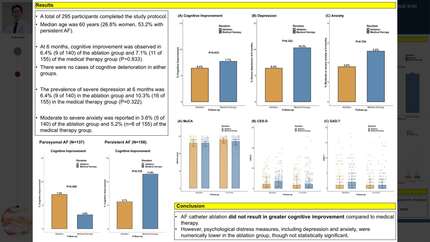
A total of 295 participants completed the study protocol. Median age was 60 years (26.8% women, 53.2% with persistent AF). At 6 months, cognitive improvement was observed in 6.4% (9 of 140) of the ablation group and 7.1% (11 of 155) of the medical therapy group (P=0.833). There were no cases of cognitive deterioration in either groups. The prevalence of severe depression at 6 months was 6.4% (9 of 140) in the ablation group and 10.3% (16 of 155) in the medical therapy group (P=0.322). Similarly, moderate to severe anxiety was reported in 3.6% (5 of 140) of the ablation group and 5.2% (n=8 of 155) of the medical therapy group.
AF catheter ablation did not result in greater cognitive improvement compared to medical therapy. However, psychological distress measures, including depression and anxiety, were numerically lower in the ablation group, though not statistically significant.


You may be interested in