The effects of atrial fibrillation burden on cognitive function and brain structure
European Heart Journal


Abstract
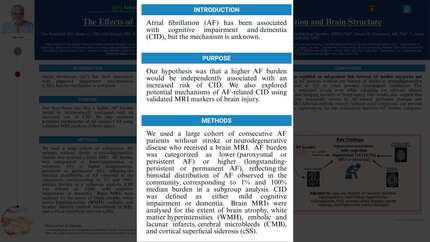
Atrial fibrillation (AF) has been associated with cognitive impairment and dementia (CID); however, the mechanisms mediating this relationship, and whether the burden of AF is associated with CID, are uncertain.
We hypothesized that the occurrence of CID would be related to a higher burden of AF, potentially through AF-related cerebral perfusion changes.
Consecutive AF patients without stroke or neurodegenerative disease who underwent brain MRI were identified from a health system registry. To estimate surrogates of higher and lower levels of AF burden, we classified AF burden into two groups, namely lower (paroxysmal/persistent AF) or higher (longstanding persistent/permanent AF). This classification was validated in a subgroup of 109 patients with quantitative AF burden data (mean AF burden: 88.34% higher vs. 16.5% lower). Brain MRIs were analysed for structural changes associated with CID, including brain atrophy (using a brain atrophy score), white matter hyperintensities (using the Fazekas scale), embolic and lacunar infarcts, cerebral microbleeds (CMB), and cortical superficial siderosis (cSS). To determine CID predictors, a multivariable model was constructed using variables with significant univariable differences (p<0.1) between patients with and without CID.
Of 834 AF patients, 114 patients (13.7%) had CID. Those with CID were more likely to have a higher AF burden category (44.7% vs 15.3%, p<0.001). In the multivariable model, higher AF burden category (adjusted odds ratio [aOR] 3.33, 95% confidence interval [CI] 2.07-5.35, p<0.001), brain atrophy score (aOR 1.09, 95% CI 1.03-1.16, p=0.005), Fazekas score (aOR 1.36, 95% CI 1.12-1.64, p=0.001), and embolic infarcts (aOR 2.11, 95% CI 1.02-4.34, p=0.045) were associated with CID, while age, sex, CHA2DS2-VASc score, lacunar infarcts, CMBs, cSS, and anticoagulant use were not. Moreover, the higher AF burden category was independently associated with higher brain atrophy scores (β=0.67, 95% CI 0.10-1.24, p=0.022) in a separate multivariable model.
Higher AF burden is independently associated with CID and brain atrophy. Brain atrophy and embolic infarcts are plausible mechanisms for mediating the effects of AF burden on cognitive impairment. White matter hyperintensities, which are mainly related to cerebral small vessel diseases, also contribute to CID in this population. Whether early and rigorous rhythm control can decrease the risk of cognitive impairment in patients with AF should be tested in randomized controlled trials.
Contributors

O Rotschild
Author
Massachusetts General Hospital - Harvard Medical School Boston , United States of America
B Le
Author
E Gokcal
Author
A Abramovitz Fouks
Author
A Das
Author
E Smith
Author
S Yaghi
Author
P Sanders
Author
S Greenberg
Author
M Chung
Author
V Reddy
Author
K Helmer
Author
E Gurol
Author
Massachusetts General Hospital - Harvard Medical School Boston , United States of America
You may be interested in