The contemporary guideline-directed medical therapy (GDMT) for heart failure is associated with a reduced incidence of new-onset atrial fibrillation in the elderly patients
European Heart Journal


Abstract
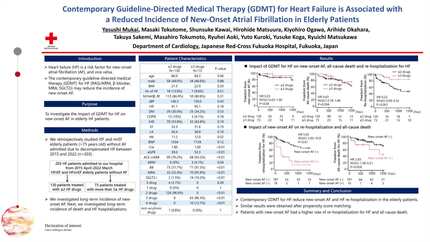
We previously reported that contemporary guideline-directed medical therapy (GDMT) for heart failure (HF) (RASi/ARNI + β-blocker + MRA + SGLT2i) reduces the incidence of new-onset of atrial fibrillation (AF). However, the efficacy is not yet known in the elderly HF patients.
We retrospectively studied the long-term incidence of new-onset AF in HFrEF and HFmrEF elderly patients (>75 years old) without history of AF (n=203) admitted to our hospital due to decompensated HF between 2015 and 2022. Patients were divided into 2 groups; patients treated with ≦2 GDMT regimen (n=130) and patients with ≧3 GDMT regimen (n=73) after discharge. The incidence of new-onset AF was significantly fewer in the ≧3 GDMT regimen group (HR 0.23, P=0.04, Figure A). In addition, re-hospitalization for HF was significantly fewer in the ≧3 GDMT regimen group (HR 0.22, P<0.01). In addition, the new-onset AF was significantly associated with re-hospitalization for HF in the studied patients (HR 5.65, P<0.001, Figure B).
The present study demonstrated that even in the elderly HF patients, the contemporary GDMT for HF was associated with a reduced incidence of new-onset AF, which might be relevant to a reduced re-hospitalization rate in the proactively treated patients.


You may be interested in