Clinical validation of the Medication Adherence Score in patients with atrial fibrillation
European Heart Journal


Abstract
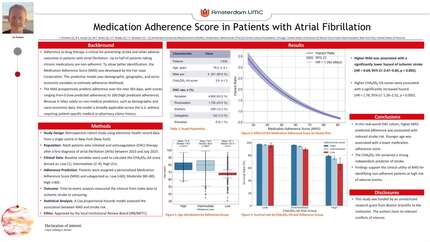
Up to half of chronic medication users are nonadherent. The Medication Adherence Score (MAS), developed by Fair Isaac Corporation (FICO), predicts medication adherence using demographic, geographic, and socio-economic factors. The model generates a 0–100 score reflecting the likelihood of adherence over the next 12 months, independent of prior refill behaviour.
To validate the MAS in patients on a direct oral anticoagulant (DOAC) regimen, using real-world clinical data.
A retrospective cohort was formed using EHR data from a single centre (New York, New York) for patients who initiated DOAC therapy between 2015 and July 2023. Time-to-event was calculated from the start of DOAC therapy after the index event to the first stroke event or to censoring (last visit or a 400-day cutoff, whichever came first). The primary outcome was ischemic stroke occurrence. Baseline demographic and clinical variables were extracted, which were used to calculate a CHA2DS2VASc score for each individual (incorporating age, sex, congestive heart failure, hypertension, diabetes, stroke/TIA, and vascular disease). Medication adherence was categorized into three groups (Low < 60, Moderate 60 - 80, High > 80). A Cox proportional hazards model was fit using with Breslow’s method for baseline hazard estimation. The model included the continuous CHA2DS2VASc score and the categorical adherence group as covariates.
Among 11,277 individuals, 538 strokes were observed. The mean age was 75.84 years (SD = 12.25), with 42.81% female. The average CHA₂DS₂-VASc score was 2.32 (SD = 1.53). Medication adherence status (MAS) was low (31.8%), moderate (60.1%), or high (8.1%). Additionally, 26.08% had hypertension, 6.99% had a prior stroke, and 45.28% reported a history of smoking.
The final Cox proportional hazards model had a partial log-likelihood of –4,846.99 and a log-likelihood ratio chi-square of 230.58 on 3 degrees of freedom (p < 0.0001). A one-point increase in the CHA₂DS₂-VASc score was strongly associated with stroke risk (HR = 1.46, 95% CI: 1.39–1.53, p < 0.005). Compared to low adherence, intermediate adherence reduced stroke risk by 43% (HR = 0.57, 95% CI: 0.42–0.78, p < 0.005), and high adherence reduced it by 59% (HR = 0.41, 95% CI: 0.29–0.57, p < 0.005).
In this real-world DOAC cohort, higher MAS-predicted adherence was consistently associated with reduced stroke risk, while the CHA2DS2VASc score remained a strong independent predictor. These findings support the clinical utility of the MAS for early identification of nonadherent patients at elevated risk, underscoring the importance of adherence interventions to optimize outcomes for anticoagulated individuals.
Contributors


You may be interested in