Topological Data Analysis for Patient Stratification and Stroke Risk in Atrial Fibrillation
European Heart Journal


Abstract
Topological Data Analysis (TDA) is an advanced mathematical framework, that uses geometric approaches to identify the shape of high-dimensional data and enables insights by visualizing complex interactions as networks.
We hypothesized that TDA would reveal patterns in classifying patients by analyzing topological features in clinical data and identifying phenotypes linked to long-term ischemic stroke outcomes in individuals with atrial fibrillation (AF).
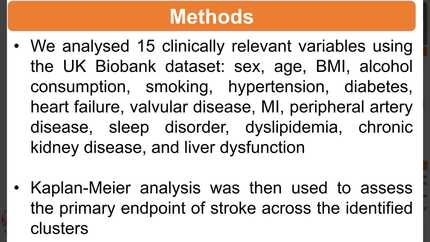
Using the UK Biobank dataset, we analyzed 15 clinically relevant variables including sex, age, BMI, alcohol consumption, smoking, hypertension, diabetes, heart failure, valvular disease, MI, peripheral artery disease, sleep disorder, dyslipidemia, chronic kidney disease, and liver dysfunction. We applied the Giotto-TDA package for Mapper analysis and leveraged the NetworkX Python package to perform the Louvain method for patient clustering. Kaplan-Meier analysis was then used to assess the primary endpoint of stroke across the identified clusters.
Among 8210 patients with an initial diagnosis of AF at the time of their first study assessment, we excluded patients who were prescribed anticoagulation and those with a previous history of stroke, 5106 patients were included in the final analysis. The mean age of patients was 57.1±4.3, and 67.5% were male. TDA resulted in five unique phenotypes summarized in Figure 2. In survival analysis, Phenotype 2, with presentation of hypertension and obesity, was associated with a significantly elevated risk of stroke (Hazard ratio 11.7, p<0.001), whilst phenotype 5, mainly males <60 years presented with the lowest risk of stroke (HR: 4.4, p=0.001).
TDA successfully divided the cohort into five distinct subsets, each with unique characteristics predictive of long-term stroke risk. This novel approach to risk stratification, driven by data topology and the underlying structure of the dataset, requires further validation to assess its clinical applicability across diverse populations and its effectiveness in identifying high-risk patients to consider anticoagulation.
Contributors




You may be interested in