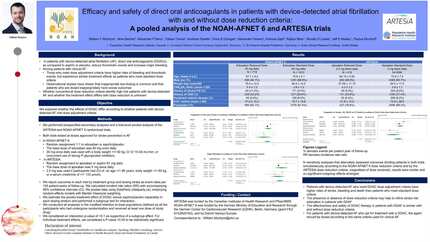
Efficacy and safety of direct oral anticoagulants in patients with device-detected atrial fibrillation with and without dose reduction criteria: a pooled analysis of ARTESiA and NOAH-AFNET 6
European Heart Journal


Abstract
In patients with device-detected atrial fibrillation (AF), direct oral anticoagulants (DOACs), as compared to aspirin or placebo, reduce thrombotic events and increase major bleeding.
We explored whether the effects of DOAC differ according to whether patients with device-detected AF met dose adjustment criteria.
We performed pre-specified secondary analyses and a trial-level pooled analysis of the ARTESiA and NOAH-AFNET 6 randomized trials. We stratified analyses based on whether or not patients met DOAC dose reduction criteria.
Among 4,012 patients in ARTESiA, 10.4% met apixaban dose reduction criteria. Among 2,354 patients in NOAH-AFNET 6, 28.4% met edoxaban dose reduction criteria.
DOACs, as compared to aspirin or placebo, decreased the risk of a composite of all-cause stroke or systemic embolism both in patients with dose adjustment criteria (1.0% vs 2.0% per patient year; risk ratio [RR] 0.50, 95% confidence interval [CI] 0.26-0.97) and in those who met standard dose criteria (0.8% vs 1.2% per patient year, RR 0.69, 95% CI 0.51-0.94); there was no evidence of treatment interaction (p interaction = 0.38).
DOACs tended to have a greater decrease in the risk of the composite of stroke, systemic embolism, myocardial infarction, pulmonary embolism or cardiovascular death in patients who were dose adjusted (4.0% vs 6.2% per patient year, RR 0.67, 95% CI 0.48-0.92) as compared to patients who received standard dose (2.7% vs 3.0% per patient year, RR 0.91, 95% CI 0.76-1.09); there was borderline significance for a subgroup effect (p interaction= 0.10). In NOAH-AFNET 6, patients fulfilling dose adjustment criteria had a greater benefit of edoxaban (p interaction = 0.03) than those fulfilling standard dose criteria.
DOACs increased the risk of major bleeding both in patients who were dose adjusted (2.7% vs 2.0%, RR 1.35, 95% CI 0.83-2.21) and those who received standard dose (1.5% vs 0.9%, RR 1.69, 95% CI 1.04-2.75); (interaction p value = 0.52).
Patients with device-detected AF who meet DOAC dose-adjustment criteria have higher rates of stroke, bleeding and death than patients who meet standard dose criteria. Overall, the effect of DOAC for all outcomes is similar in both standard and reduced dose strata.
There was for a possible greater absolute benefit for edoxaban against the stroke, systemic embolism, myocardial infarction, pulmonary embolism or cardiovascular death outcome in the reduced dose strata in the NOAH-AFNET 6 trial. This requires further study using patient-level data.
Contributors





You may be interested in