From ischaemia to arrhythmia. Predicting atrial fibrillation after an acute coronary syndrome. Insights from the BACS & BAMI study
European Heart Journal


Abstract
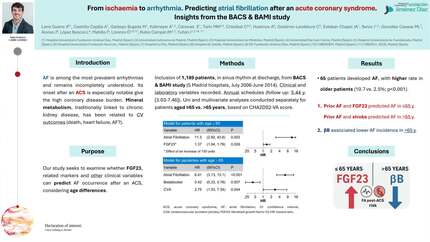
Atrial fibrillation (AF) remains incompletely understood. Its prevention and prediction constitute active areas of research, especially in patients who have an acute coronary syndrome (ACS). Recently, mineral metabolism, traditionally linked to chronic kidney disease, has been acknowledged as a key contributor of cardiovascular disease, regardless of renal function. Specifically, fibroblast growth factor 23 (FGF23) has emerged as a robust predictor of heart failure and death, with apparent trends towards increased risk of AF. Nevertheless, its specific predictive value for AF after an ACS remains underexplored.
To examine the potential ability of FGF23 and other components of mineral metabolism, along with clinical variables, to predict AF occurrence after an ACS. To assess if these predictors are different in old versus young patients.
We analysed 1,189 patients with ACS from the BACS & BAMI (Biomarkers in Acute Coronary Syndromes & Biomarkers in Acute Myocardial Infarction) study who were not in AF at discharge. Clinical variables were recorded at admission. Fasting venous blood samples were withdrawn and stored in frozen plasma (-80º). Patients were followed by examining of the clinical records and with phone interviews. The primary outcome was the occurrence of any type of AF. For analysis, they were divided in two subgroups: patients ≤65 years and >65 years. Baseline quantitative data were compared using t-Student for those with normal distribution, and Mann-Whitney U for those not following a normal distribution. Qualitative data were compared by χ² tests. Univariate Cox regression test and subsequent multivariate regression analysis were performed.
The median follow-up was 5.44 (3.03-7.46) years. Baseline characteristics for both subgroups are shown in Table 1. Out of 1,189 patients, 65 developed AF, with higher incidence in older patients (10.7% vs. 2.5%, respectively; p<0.001). At multivariate analysis, previous AF and FGF23 plasma levels showed a positive and independent association with the occurrence of AF during the follow-up in patients ≤65 years (Table 2). In those >65 years, betablocker treatment was independently associated with a lower incidence of AF, while previous AF and prior stroke were strong predictors of AF occurrence.
Following an ACS, FGF23 levels were independently associated to AF development in patients ≤65 years. On the other hand, previous stroke emerged as a significant predictor of AF in patients >65 years, while betablocker therapy seems to provide a protective effect in these patients. Additionally, a history of prior AF was a consistent predictor of future AF across both groups. These insights may enhance risk stratification and guide individualized strategies in terms of AF prevention after an ACS. Baseline characteristics Mutlivariate analysis
Contributors

J Alonso
Author
O Lorenzo
Author

J Tunon
Author

A Castrillo Capilla
Author
M Garbayo Bugeda
Author
J A Esteban Chapel
Author
A Kallmeyer
Author
E Canovas
Author
C Cristobal
Author
A Huelmos
Author
M Nieves Tarin
Author
J Senra
Author
M L Gonzalez Casaus
Author
You may be interested in