Emergence of sex differences on the risk of left atrial fibrosis in atrial fibrillation - a REAL-AF study
European Heart Journal


Abstract
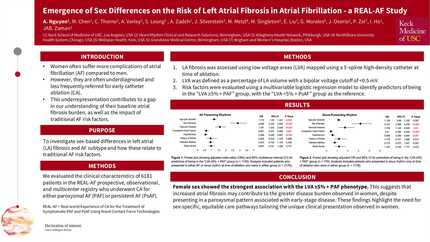
Despite women suffering more adverse complications of atrial fibrillation (AF) compared to men, they are often underdiagnosed and less frequently referred for early catheter ablation (CA). This underrepresentation contributes to a gap in our understanding of their baseline atrial fibrosis burden, as well as the impact of traditional AF risk factors.
To investigate sex-based differences in left atrial (LA) fibrosis, traditional AF risk factors, and AF subtype.
The Real-world Experience of CA for the Treatment of Symptomatic Paroxysmal AF (PAF) and Persistent AF (PsAF) Using Novel Contact Force Technologies registry (REAL-AF) is a prospective, observational multicenter registry of patients undergoing CA. We evaluated the clinical characteristics of 6181 patients who underwent CA for either PAF or PsAF. LA fibrosis was assessed using low voltage areas (LVA) mapped using a 5-spline high density catheter. LVA was defined as bipolar voltage <0.50 mV, indexed to LA volume. Risk factors were assessed using a logistic regression model for their association to the "LVA ≥5% + PAF" or "LVA <5% + PsAF" group.
Women were more likely to have PAF with LVA ≥5% at the time of CA (odds ratio (OR) = 2.86, 95% CI: 2.33–3.50, p <0.001) (Figure 1). Advancing age (OR = 1.17 per decade, p = 0.023) and vascular disease (OR = 1.58, p <0.001) were also associated with PAF and LVA ≥5%, whereas congestive heart failure (OR = 0.60, p = 0.001) and hypertension (OR = 0.56, p < 0.001) were less likely to be present. Stroke, diabetes, and sleep apnea showed no significant associations to either group. Other than age, these associations remained significant for patients who presented in sinus rhythm at time of ablation (N = 3691) (Figure 2).
Women had the strongest association with PAF and LVA ≥5%. Increased LVA may explain why women have more adverse sequelae of the disease despite presenting in a paroxysmal pattern. This underscores the need for sex-specific, equitable care pathways tailoring the unique clinical presentation observed in women.
Contributors

M Chen
Author
C Thorne
Author
A Varley
Author
S Leung
Author
A Zadeh
Author
J Silverstein
Author
M Metzl
Author
M Singleton
Author
E Liu
Author
G Morales
Author
J Osorio
Author
P Zei
Author
I Ho
Author
J A B Zaman
Author
You may be interested in