Stimulated periodic repolarisation dynamics as a predictor of new-onset device-detected atrial fibrillation
European Heart Journal


Abstract
Periodic Repolarisation Dynamics (PRD) is a novel ECG-based risk marker reflecting low-frequency oscillations in cardiac repolarisation, caused by efferent sympathetic nervous system activity. Elevated PRD (≥ 5.75 deg²) predicts malignant arrhythmias and sudden cardiac death in both ischaemic and non-ischaemic cardiomyopathy. The relationship between PRD and atrial arrhythmias, particularly atrial fibrillation (AF), remains unclear despite growing evidence of cardiac autonomic dysfunction (c-AD) in AF pathogenesis. This study examines the relationship between c-AD, as measured by PRD, and the incidence of device-detected atrial fibrillation (DDAF) in patients with implanted cardiac pacemakers.
In the observational ACasA study, patients with implanted cardiac pacemakers were prospectively enrolled. High-resolution ECG recordings under native (AAI) and stimulated (DDD) conditions were used to calculate PRD at the baseline visit. c-AD was defined by native PRD ≥ 5.75 deg² and stimulated PRD > 4.3 deg², as determined by the Youden index method. DDAF episodes (≥ 6 minutes) were identified via continuous telemedical pacemaker monitoring. The primary endpoint was time to first DDAF episode, analysed with Kaplan-Meier curves and Cox regression to assess the relationship between PRD and DDAF, adjusting for potential confounders.
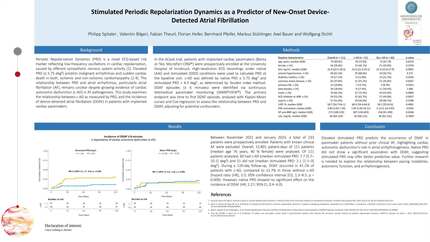
Between November 2021 and January 2024, a total of 233 patients were prospectively enrolled. Patients with known clinical AF were excluded. Overall, 13,801 patient-days of 111 patients (median age 76 years, 44% female) were analysed. Of the 111 patients analysed, 60 had c-AD (median stimulated PRD: 7.7 [5.7–8.6] deg²) and 51 did not (median stimulated PRD: 3.8 [2.0–7.3] deg²). During a 120-day follow-up, DDAF occurred in 41.2% of patients with c-AD, compared to 21.7% in those without c-AD (hazard ratio [HR], 3.3; 95% confidence interval [CI], 1.3–8.5; p = 0.009). However, native PRD showed no significant effect on the incidence of DDAF (HR, 1.27; 95% CI, 0.4–4.0).
Elevated stimulated PRD predicts the occurrence of DDAF in pacemaker patients without prior clinical AF, highlighting cardiac autonomic dysfunction’s role in atrial arrhythmogenesis. Native PRD did not show a significant association with DDAF, suggesting stimulated PRD may offer better predictive value. Further research is needed to explore the relationship between pacing modalities, autonomic function, and arrhythmogenesis.


You may be interested in