Clinical characteristics and adverse outcomes in newly diagnosed atrial fibrillation: a report from two prospective registries in europe and east-asia
European Heart Journal


Abstract
Clinical characteristics and outcomes in patients with atrial fibrillation (AF) are dynamic and vary from the time of diagnosis to more advanced stages.
To assess differences in clinical characteristics and outcomes between patients with newly diagnosed AF and those with previously diagnosed AF.
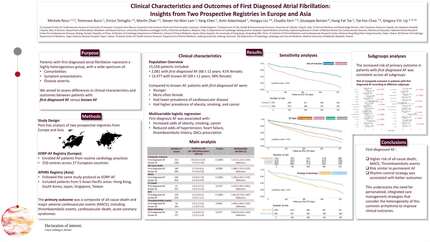
A post-hoc analysis of two prospective registries enrolling AF patients from EORP-AF Registry, and from APHRS-AF Registry. Logistic regression was used to identify factors associated with first-diagnosed AF. Multivariable Cox regression analysis was conducted to estimate the hazard ratio (HR) and 95% confidence intervals (CI) for the risk of adverse outcomes in patients with newly diagnosed AF compared to those with previously diagnosed AF. Multivariable models were adjusted for: age ≥75 years, female sex, group (European vs. Asian), BMI>30 kg/m², smoking, hypertension, diabetes, coronary artery disease, peripheral vascular disease, heart failure, thromboembolic event, chronic kidney disease, dementia, cancer and use of OAC. The primary outcome was a composite of all-cause death and major adverse cardiovascular events (MACE). Secondary outcomes included all-cause death, MACE, major bleeding, and exploratory analyses of each MACE component, including thromboembolic events, cardiovascular death, and acute coronary syndromes. Sensitivity analysis evaluated the risk of adverse events in patients with AF newly diagnosed with each AF type (paroxysmal, persistent, and permanent).
The overall population of 15,558 participants was divided into two groups based on the timing of AF diagnosis: first-diagnosed AF (n=2,081: age: 68 ± 12 years, 41% female) and known AF. Patients with first-diagnosed AF were younger, more often female, had a lower prevalence of cardiovascular burden but higher prevalence of obesity, smoking and cancer. After a median follow-up of 714 days (IQR: 370.5-742.0), first-diagnosed AF had a higher incidence of the primary outcome (annual incidence rates: 10.6% vs. 7.4% per year, P < 0.001), all-cause death (5.7 vs. 4.7, P = 0.0298), MACE (6.9 vs. 4.5, P < 0.001), acute coronary syndrome (3.4 vs. 1.9, P < 0.001), and thromboembolic events (2.0 vs. 1.1, P = 0.0002). On multivariable Cox regression analysis (Table 1), first-diagnosed AF was associated with a higher risk of the primary outcome (HR: 1.31; CI: 1.12-1.54), all-cause death (HR: 1.39; CI: 1.15-1.67), MACE (HR: 1.27; CI: 1.02-1.58), and thromboembolic events (HR: 1.50; CI: 1.04-2.15). No statistically significant differences were found for other outcomes. The risk of composite outcome in first diagnosed AF was lower than in patients with paroxysmal and persistent AF but similar to those with permanent AF (Figure 1A, B).
The increased risk of adverse events in newly diagnosed AF patients highlights the need for prompt adoption of holistic or integrated care strategies to improve clinical outcomes.


You may be interested in