Patients with patent foramen ovale or atrial septal defect have worse outcomes after pulmonary vein isolation
European Heart Journal


Abstract
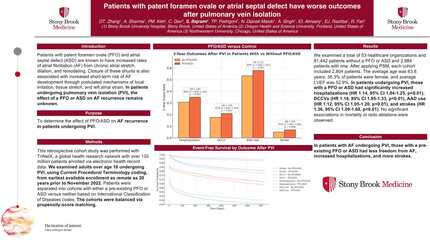
Patients with patent foramen ovale (PFO) and atrial septal defect (ASD) are known to have increased rates of atrial fibrillation (AF) from chronic atrial stretch, dilation, and remodeling. Closure of these shunts is also associated with increased short-term risk of AF development through postulated mechanisms of local irritation, tissue stretch, and left atrial strain. In patients undergoing pulmonary vein isolation (PVI), the effect of a PFO or ASD on AF recurrence remains unknown.
To determine the effect of PFO/ASD on AF recurrence in patients undergoing PVI.
This retrospective cohort study was performed with TriNetX, a global health research network with over 130 million patients enrolled via electronic health record data. We examined adults over age 18 undergoing PVI, using Current Procedural Terminology coding, from earliest available enrollment as remote as 20 years prior to November 2022. Patients were separated into cohorts with either a pre-existing PFO or ASD versus neither based on International Classification of Diseases codes. The cohorts were balanced via propensity-score matching (PSM) with the following covariates: age, gender, race, comorbidities (hypertension, ischemic heart disease/atherosclerosis, heart failure/cardiomyopathy, cerebrovascular disease, obstructive sleep apnea, diabetes mellitus, obesity, chronic kidney disease), left ventricular ejection fraction, body mass index, and cardiovascular medications. Outcomes included mortality, hospitalization, redo AF ablation, direct current cardioversion (DCCV), antiarrhythmic drug (AAD) use, and stroke for a two-year follow-up period from index procedure.
We examined a total of 53 healthcare organizations and 81,442 patients without a PFO or ASD and 2,884 patients with one. After applying PSM, each cohort included 2,804 patients. The average age was 63.8 years, 35.3% of patients were female, and average LVEF was 52.9%. In patients undergoing PVI, those with a PFO or ASD had significantly increased hospitalizations (HR 1.14, 95% CI 1.04-1.25, p<0.01), DCCVs (HR 1.18, 95% CI 1.05-1.33, p<0.01), AAD use (HR 1.12, 95% CI 1.05-1.20, p<0.01), and strokes (HR 1.36, 95% CI 1.09-1.68, p<0.01). No significant associations in mortality or redo ablations were observed.
In patients with AF undergoing PVI, those with a pre-existing PFO or ASD had less freedom from AF, increased hospitalizations, and more strokes.
Contributors

A Sharma
Author
P M Kim
Author
C Gier
Author
S Bajrami
Author
T P Fedrigoni
Author
N Dianati Maleki
Author
A Singh
Author
I O Almasry
Author
E J Rashba
Author
R Fan
Author
You may be interested in