Higher ambient maximum temperature leads to prolonged device detected atrial fibrillation episodes
European Heart Journal


Abstract
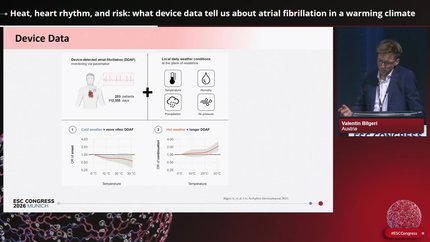
Cardiac pacemakers with an atrial lead provide continuous monitoring of device-detected atrial fibrillation (DDAF). Using modern meteorological systems high-resolution analyses correlations of various weather factors with the incidence and daily burden of DDAF can be detected.
Patients implanted with a transvenous cardiac pacemaker without permanent AF were prospectively enrolled in the ongoing observational ACaSA study. For each day of follow-up, high-resolution local meteorological data were extracted from the national Austrian weather system and assigned to the individual patient’s place of residence, located in different altitudes and therefore different climatic conditions. The influence of prespecified weather parameters — ambient temperature, humidity, precipitation, and air pressure change — on daily onset and continuation of DDAF was assessed using a case-crossover design estimated via conditional logistic regression and a discrete time-to-event model, respectively.
The analysis included 112,355 patient-days of 203 study participants. Median age was 75 years [IQR 69-80]; 37.9 % were female; median follow up was 549 [IQR 344–784] days. Data were collected between March 2022 and November 2024. Low ambient temperature (p=0.044) and air pressure change (p<0.001) showed a significant correlation with DDAF onset in a multivariate analysis. However, higher ambient temperature was associated with longer DDAF episodes. On days with a maximal ambient diurnal temperature of 30°C, OR was 2.76 (95% CI: 1.58–4.83) for continuation of the DDAF episode until the following day (p=0.002) compared to reference days with 0°C. Relative humidity showed a weak association with DDAF continuation (p = 0.022), whereas precipitation did neither correlate with onset nor continuation.
The association of high ambient maximum diurnal temperature with prolonged DDAF episodes could be of clinical importance in view of upcoming heat waves and extreme weather events due to current climate changes. DDAF onset DDAF continuation
Contributors

V Bilgeri
Author
P Rockenschaub
Author
F Lehner
Author
L Tschiderer
Author
F Barbieri
Author

H Formayer
Author
A Bauer
Author
W Dichtl
Author
You may be interested in