Integrating pre- and post-ablation B-type natriuretic peptide to identify high-risk population for long-term adverse events and arrhythmic recurrence in persistent atrial fibrillation
European Heart Journal


Abstract
Pre- and post-procedural plasma B-type natriuretic peptide (BNP) levels can predict rhythm outcomes after catheter ablation for atrial fibrillation (AF). However, the significance of long-term events remains unclear. Therefore, this study aimed to investigate the significance of integrating pre- and post-ablation BNP levels on major adverse cardiovascular events (MACE) and arrhythmic recurrence in patients with persistent AF undergoing catheter ablation.
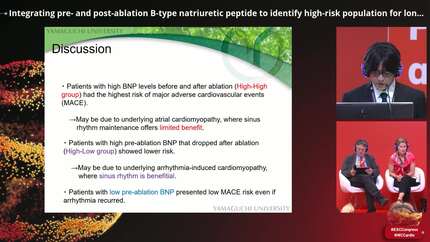
We analysed 392 patients who underwent first catheter ablation. Patients were stratified into four subgroups based on pre-ablation plasma BNP level and its relative change after ablation (ΔBNP) using their respective median values (pre-ablation BNP: 148.0 pg/mL, ΔBNP: -52.6%): Low-Low (pre-ablation <148.0 pg/mL, ΔBNP < -52.6%), Low-High (pre-ablation <148.0 pg/mL, ΔBNP ≥ -52.6%), High-Low (pre-ablation ≥148.0 pg/mL, ΔBNP < -52.6%), and High-High (pre-ablation ≥148.0 pg/mL, ΔBNP ≥ -52.6%). The primary endpoint was MACE, which included all-cause death, heart failure hospitalisation, and other cardiovascular hospitalisations. The secondary endpoint involved arrhythmic recurrence.
Of the 392 patients, 101 were classified as Low-Low, 91 as Low-High, 97 as High-Low, and 103 as High-High. During a median follow-up of 5.3 (interquartile range: 3.2–7.2) years, 63 patients (16%) experienced MACE. Heart failure hospitalisation accounted for the majority of events (63%). The High-High subgroup showed significantly higher MACE rates than others (cumulative incidence [95% confidence interval]: 26.3% [16.2–35.2], p < 0.001). Low-High and High-High subgroups demonstrated a higher arrhythmic recurrence (p < 0.001). After multivariate adjustment, the High-Low and High-High subgroups demonstrated progressively higher risks of MACE incidence compared to the Low-Low and Low-High subgroups. Both Low-High and High-High subgroups showed an elevated arrhythmic recurrence risk (both p < 0.001).
Integrating pre- and post-ablation BNP levels can be useful for identifying patients with persistent AF at high risk of MACE and arrhythmic recurrence during long-term follow-up (Figure 1: Graphical abstract, Figure 2: Risk stratification flow diagram using pre- and post-ablation BNP). graphical abstract Risk stratification flow diagram

You may be interested in