Prevalence of sinus node dysfunction in patients with implantable cardiac monitor for cryptogenetic stroke: a manifestation of atrial cardiomyopathy?
European Heart Journal


Abstract
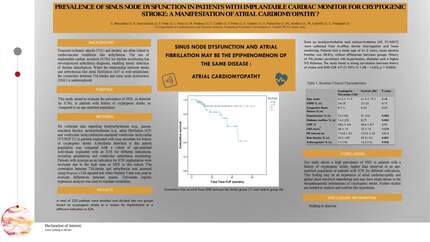
Transient ischemic attacks (TIA) and strokes, are often linked to cardiovascular conditions like arrhythmias. The use of implantable cardiac monitors (ICMs) for rhythm monitoring has revolutionized arrhythmia diagnosis, enabling timely detection of rhythm disturbances. While the relationship between stroke and arrhythmias like atrial fibrillation (AF) is well-established, the connection between TIA/stroke and sinus node dysfunction (SND) is underexplored.
This study aimed to evaluate the prevalence of SND, as detected by ICMs, in patients with history of cryptogenetic stroke, as compared to an age-matched population
We collected data regarding bradyarrhythmias (e.g., pauses, sinoatrial blocks), tachyarrhythmias (e.g., atrial fibrillation (AF) and ventricular tachycardia/non-sustained ventricular tachycardia (VT/NSVT)) in patients implanted with loop recorders for history of cryptogenetic stroke. Arrhythmia detection in this patient population was compared with a cohort of age-matched individuals implanted with an ICM for different indications, including palpitations and ventricular arrhythmia monitoring. Patients with syncope as an indication for ICM implantation were excluded due to the high rates of SND in this cohort. The correlation between TIA/stroke and arrhythmias was assessed using Pearson’s Chi-squared test while Student T-test was used to evaluate differences between means. Univariate logistic regression analysis was used to validate correlation.
A total of 225 patients were enrolled and divided into two groups based on cryptogenetic stroke as a reason for implantation or a different indication to ICM. Data on bradyarrhythmias and tachyarrhythmias (AF, VT/NSVT) were collected from in-office device interrogation and home monitoring. Patients had a mean age of 61.2 years, mean ejection fraction was 58.6%, without differences between groups. History of TIA/stroke correlated with hypertension, diabetes and a higher IVS thickness. The study found a strong correlation between history of stroke and SND (OR 4.717; 95% CI 1.58 - 14.03; p = 0.005).
Our study shows a high prevalence of SND in patients with a history of cryptogenic stroke, higher than observed in an age-matched population of patients with ICM for different indications. This finding may be an expression of atrial cardiomyopathy and global atrial electrical remodeling and may have implications in the etiopathogenetic mechanisms of cryptogenic stroke. Further studies are needed to explore and confirm this hypothesis.
Contributors

L Fulco
Author
C Cardile
Author
F Perna
Author
G Comerci
Author
G Pinnacchio
Author
M L Narducci
Author
F A Gabrielli
Author
G Pelargonio
Author
You may be interested in