NT-proBNP may be used as a risk factor of stroke after the elimination of atrial fibrillation by catheter ablation
European Heart Journal


Abstract
The risk factors for stroke after atrial fibrillation (AF) ablation have not been well studied. Previous studies have reported that the risk of stroke was high in patients with advanced atrial cardiomyopathy, irrespective of the presence or absence of AF. Elevated blood N-terminal pro-brain natriuretic peptide (NT-proBNP) levels may reflect atrial dysfunction, or severity of atrial cardiomyopathy after the elimination of AF by ablation in patients without obvious cardiac disease except for AF. Therefore, we hypothesized that NT-proBNP levels after ablation could be used as a risk indicator of stroke.
This study aims to investigate the association between NT-proBNP levels measured six months after AF ablation and the incidence of stroke during 5-years follow up period in patients who did not experience AF recurrence and do not have apparent left ventricular disease.
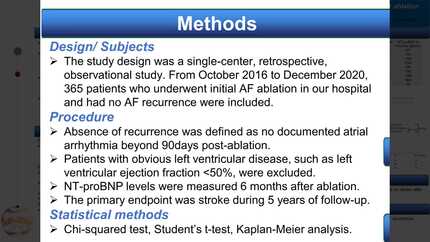
The study design was a single-center, retrospective, observational study. From October 2016 to December 2020, 365 patients who underwent initial AF ablation in our hospital and had no AF recurrence were included (age, 71±11 years; female, 119 [33%]; persistent AF, 50 [14%]). Patients with obvious left ventricular disease, such as left ventricular ejection fraction <50%, were excluded. NT-proBNP levels were measured 6 months after ablation. Patients were divided into three groups: NT-proBNP<125 pg/mL, 125 ≤NT-proBNP<220 pg/mL, and NT-proBNP≥220 pg/mL. The primary endpoint was stroke during 5 years of follow-up.
The median NT-proBNP level was 101 (45, 229) pg/mL. Stroke occurred in 9 (2.5%) patients. The group that experienced stroke had significantly higher levels of NT-proBNP compared to the group that did not (1055 pg/mL versus 230 pg/mL p<0.001). There was no significant difference in CHA2DS2VASc score between the groups with and without stroke (3.9 versus 2.5 p=0.87). On log-rank test, stroke developed more frequently in patients with NT-pro BNP≥220 pg/mL than those with NT-pro BNP<125 pg/mL (Figure 1).
A high NT-proBNP level six months after ablation predicted the development of stroke during the 5-years follow-up period in patients without AF recurrence.

You may be interested in