The relationship between reported endurance exercise and atrial fibrillation in middle-aged males
European Heart Journal


Abstract
The relationship between long-term endurance exercise and atrial fibrillation (AF) remains debated. While physical activity is known to reduce traditional cardiovascular risk factors, evidence suggests higher volumes of intense exercise may increase AF risk. The threshold for increased AF due to long-term endurance exercise remains unknown.
We sought to assess the relationship between the self-reported amount of endurance exercise and AF in a middle-aged male population.
We analysed questionnaire data from middle-aged male volunteers for the Master@Heart study, assessing self-reported exercise history, cardiovascular risk factors and history of AF. Self-reported exercise history included endurance training load (TL; hours per week) and discipline. Multivariate logistic regression was performed to assess the relationship between TL and history of AF.
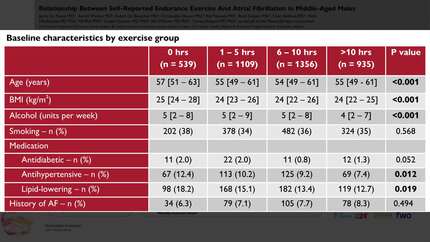
Complete questionnaire data was available for 3939 middle-aged males. A history of AF was reported by 7.5% of the population. Those with history of AF were older (59 [53 – 65] years) compared to those without (55 [49 – 61] years, p<0.001). The AF group had a higher prevalence of medication use for diabetes (4% vs 1%, p=0.002), hypertension (16% vs 9%, p<0.001), and dyslipidemia (27% vs 13%, p<0.001) compared to the non-AF group. Median TL was not significantly higher in the AF group (8 [4 -11] h/week) than the non-AF group (6[3 – 8] h/week, p=0.076). AF prevalence was higher in individuals with ≥5 hours of weekly exercise compared to those with <5 hours (8% VS 6%, p=0.013), with the ≥5 h/week threshold chosen based on the most significant difference in AF prevalence (Abstract Picture 1). Training load ≥5h/week was an independent predictor of AF history in a multivariate logistic regression model adjusting for age, smoking behaviour and medication use for diabetes, hypertension or dyslipidemia (OR 1.53, 95% CI [1.17 – 1.99], p=0.002) (Abstract Picture 2).
In a middle-aged male population, higher training load (≥5 h/week) was associated with history of AF, even after adjusting for other risk factors. These findings support that higher volumes of intense endurance exercise may increase the risk of AF, despite a more favourable traditional risk profile.
Contributors



You may be interested in