Increased incidence of elevated troponin levels and low indicence of acute conorary syndrome in patients presenting with atrial fibrillation in the emergency department.Data from the HEROMEDICUS study
European Heart Journal


Abstract
Atrial fibrillation (AF) is a common arrhythmia frequently seen in the emergency department (ED). Troponin, a biomarker for myocardial injury, is often measured in these patients, even in the absence of suspected acute coronary syndrome (ACS). The incidence and clinical significance of elevated troponin in the context of AF in the ED are not fully understood.
To examine the incidence of elevated troponin levels in AF patients presenting to the ED and explores their potential impact on diagnosis, prognosis, and treatment decisions.
This retrospective study reviewed the charts of patients diagnosed with AFflutter/tachycardia who visited our hospital's ED from September 2023 to October 2024. We assessed the number of patients with elevated troponin levels and whether these patients were treated for ACS. Demographic data, medical history, laboratory results, and imaging findings were analyzed.
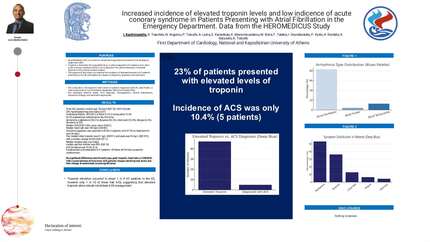
From September 2023 to October 2024, a total of 202 patients with AF (83%), atrial flutter (4.2%), atiral tachycardia (12.8%) presented to the ED, of which 47 (23.3%) had elevated troponin levels. Over half of the patients (55.3%) were experiencing arrhythmia for the first time.
Most common symptoms reported were palpitations (53.2%), dyspnea (36.2%), chest pain (12.8%), fatigue (6.4%), and dizziness (4.3%). Median age of the patients was 78 years (IQR 10), and 59.6% were female. Median CHA2DS2-VA score was 3 (IQR 2), and median ventricular rate was 130 beats per minute (IQR 40). Nearly half of the patients (45.8%) were already on oral anticoagulants, with 37.5% having been on them for more than 30 days.
Troponin levels varied: median peak troponin level was 94 ng/L (IQR 351), with an initial median level of 41 ng/L (IQR 91). The median change in troponin levels was 58% (IQR 207.1). Median length of hospital stay was 3 days, and median ejection fraction was 45% (IQR 15). A total of 5 patients (10.4%) had ACS. Cardioversion was attempted in 47 patients, with 27 (57.45%) undergoing either pharmaceutical (17%) or electrical (40.4%) cardioversion. Of these, 23 patients (48.9%) achieved successful cardioversion, while 4 patients (8.51%) did not.
There were no statistically significant differences in age, maximum troponin levels, ejection fraction, duration of hospitalization, CHA2DS2-VASc scores, or heart rate between patients with ACS and those without. However, initial troponin levels and changes in troponin levels showed trends toward significance (p = 0.05 and p = 0.07, respectively), suggesting that early troponin markers may differ between the two groups and warrant further investigation.
Elevated troponin leves are revealed in 1 out of 4 patients with AF presented in ED. Among them only one 1 out of 10 suffers from ACS
Contributors


N Argyriou
Author
P Tsioufis
Author
A Laina
Author
A E Karanikola
Author
K Mavromoustakou
Author
M Botis
Author
F Tatakis
Author
I Doundoulakis
Author
A Kordalis
Author
K Tsioufis
Author
You may be interested in