Genetic traits associated with plasma atrial biomarker BMP10: GWAS and Mendelian randomization study on stroke and heart failure in patients with atrial fibrillation
European Heart Journal


Abstract
Bone morphogenetic protein 10 (BMP10) has emerged as a novel atrial specific biomarker. BMP10 is associated with increased risk of developing atrial fibrillation (AF), as well as increased risk of ischemic stroke and other cardiovascular outcomes in patients with AF. This study aimed to identify genetic variants associated with plasma levels of BMP10 and to evaluate their causal relationship with subsequent stroke or heart failure in patients with AF.
Genome wide association studies (GWAS) with subsequent GWAS meta-analysis were performed for BMP10 plasma levels. GWAS was performed in in patients with chronic coronary artery disease from the STABILITY trial (n = 8,061) and patients with AF from the ARISTOTLE trial (n = 4,296). Both studies had genotypes imputed using the haplotype reference consortium v1.1 reference panel. Analyses were performed adjusting for each GWAS significant SNP (p < 5e-8) until no signals were left. In the GWAS analyses BMP10 was inverse normal rank transformed. To assess the causal effect of BMP10 the GWAS findings were used in mendelian randomization analyses (MR). MR was performed in the ARISTOTLE (n = 5,553) and RE-LY (n = 2,962) trials. Single SNP analyses were performed using Cox-regression and meta-analyzed using a fixed effects model. The results were combined using two step least squares and an inverse variance-weighted method accounting for genetic linkage-disequilibrium as implemented in the ‘MendelianRandomization’ package in R.
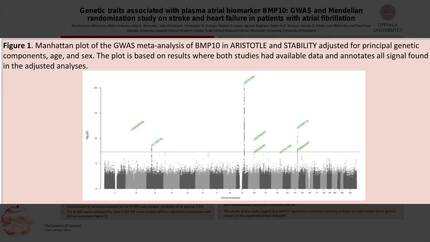
In a sample of 12,357 patients, eight single nucleotide polymorphisms (SNPs) , reached genome-wide significance in the GWAS meta-analysis of BMP10 (Figure 1). Most signals were trans acting with one cis acting variant. The strongest association was observed at rs2761681 (Chr 9, β = -0.1234, P= 1.86 x10⁻²¹, minor allele frequency 32% in STABILITY) in the CENPP gene. The second signal was a cis missense variant rs34008398 (Chromosome 2, β = -0.4063, P= 1.04x10⁻¹², minor allele frequency 1% in STABILITY) in the BMP10 gene. In total the amount of variance explained by the 8 variants was modest with a combined r2 of ~2.5%. The 8 SNPs were used in a MR analysis, which did not show a significant association with all-cause stroke, ischemic stroke, or hospitalization for heart failure (Figure 2).
In this first large-scale cohort study investigating the genetic regulation of BMP10, several SNPs were identified to be associated with BMP10 plasma levels. Mendelian randomization meta-analysis, however, did not suggest a significant causal relationship between BMP10 plasma level and cardiovascular outcomes in patients with AF.
Contributors



You may be interested in