Atrial fibrillation increases pulmonary capillary wedge pressure in patients with chronic cardiac diseases
European Heart Journal


Abstract
Pulmonary capillary wedge pressure (PCWP) increase is the hemodynamic marker of heart failure and is associated with worse cardiovascular outcomes. Atrial fibrillation (AF) also contributes to poorer cardiovascular outcomes and is associated with several cardiac diseases. AF may either be the consequence or cause for the worsening of several cardiac diseases. AF is associated with higher PCWP than sinus rhythm (SR). However, the independent effect of AF on PCWP increase has not been sufficiently explored in the past.
We aimed to assess whether AF causes an increase in PCWP compared to SR in patients with different cardiac diseases.
We performed a retrospective, single-center, observational, cross-sectional study. From May 2015 to December 2022, we enrolled 1051 patients with various chronic cardiac diseases who underwent a clinically indicated right heart catheterization (RHC). All patients were hemodynamically stable. PWCP was measured from RHC pressure curves. Demographics, clinical, electrocardiographic, and echocardiographic data were obtained from patients’ chart records.
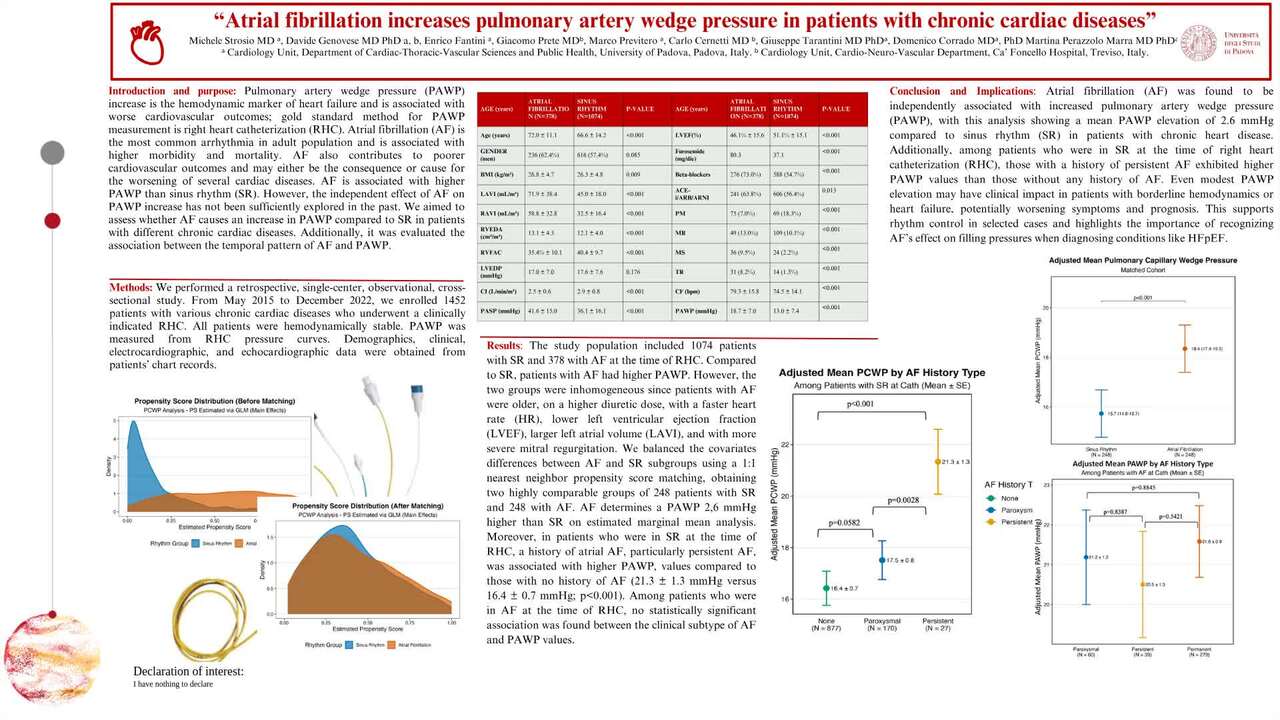
The study population included 790 patients with AF and 261 with SR at the time of RHC. Compared to SR, patients with AF had higher PCWP. However, the two groups were inhomogeneous since patients with AF were older, on a higher diuretic dose, with a faster heart rate (HR), lower left ventricular ejection fraction (LVEF), larger left atrial volume (LAVol), and with more severe mitral regurgitation. Interestingly, the two groups' left ventricular end-diastolic pressure was comparable (Table 1). We balanced the covariates differences between AF and SR subgroups using a 1:1 nearest neighbor propensity score matching, obtaining two highly comparable groups of 176 patients with AF and 176 with SR (Table 1). AF determines a PCWP 2,6 mmHg higher than SR on estimated marginal mean analysis. This finding was confirmed by the multivariate analysis (Figure 2). Furthermore, within patients with AF at the time of RHC, those with a history of persistent or permanent AF had higher PWCP than patients with paroxysmal AF.
AF determines a mean increase in PCWP of 2.8 mmHg compared to SR among patients with chronic cardiac diseases. Within AF patients, PCWP is lower in paroxysmal than persistent or permanent AF.
Contributors

M D P H D Genovese Davide
Author
M D Prete Giacomo
Author
M D Previtero Marco
Author
M S Palermo Chiara
Author
M D P H D Fraccaro Chiara
Author
M D P H D Tarantini Giuseppe
Author
You may be interested in